
A Milos jeep tour leaves the asphalt behind and crosses rough ground on the island of Milos. The tour leader takes the group west in a four-wheel-drive vehicle, along dirt tracks. The route ends at far-off beaches and high lookouts that ordinary cars struggle to reach. Villages and crowds stay far behind.
Milos is a volcanic island in the southwestern Cyclades. Rugged hills fill the larger share of the land. The main towns sit around the big bay. The western half has no villages at all. This page explains how a Milos jeep tour works and what a 4×4 can do there.
What is a Milos jeep tour at a glance?
A Milos jeep tour is an escorted drive in a four-wheel-drive vehicle. It crosses the wild western half of the island on dirt tracks. The route ends at remote beaches and hilltop viewpoints that ordinary cars find hard to reach.
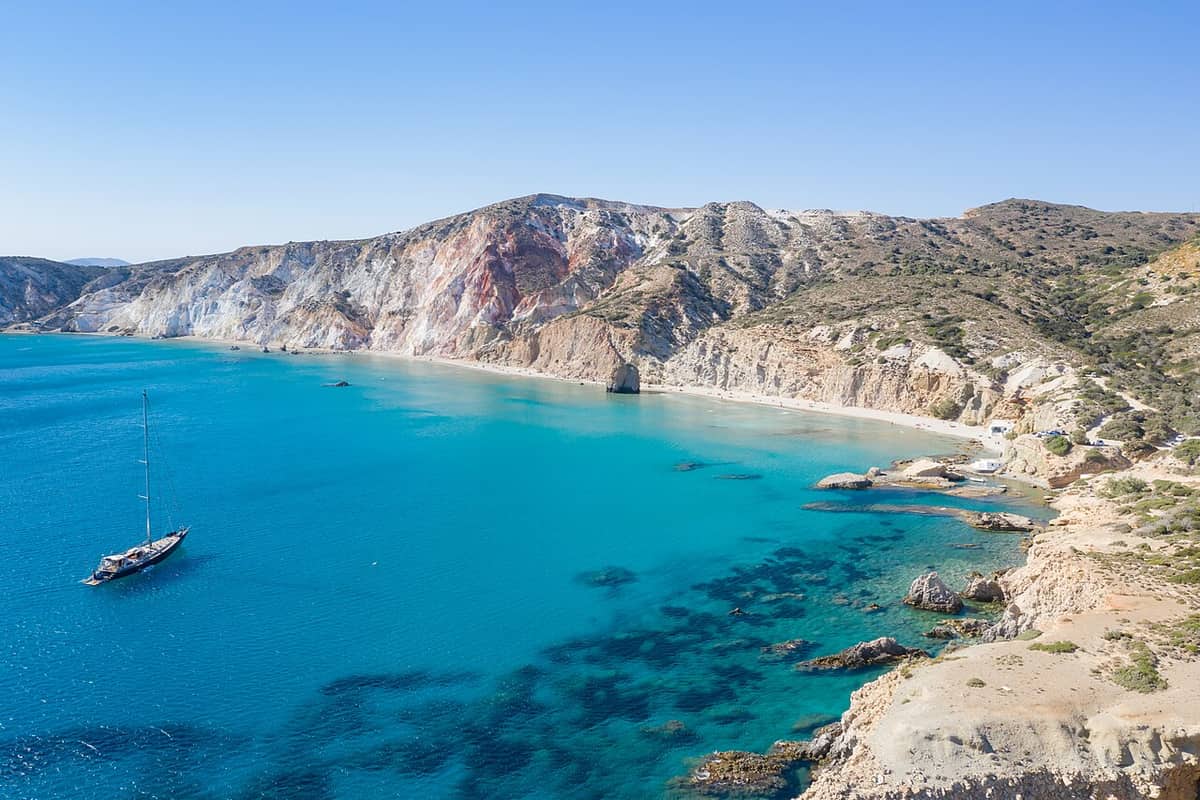
The west is where Milos turns rough and empty. No village stands there. Only a handful of tiny settlements and old mines dot the empty land. A Milos jeep tour is built around this quiet corner.
Almost all of the west belongs to Natura 2000, a European Union network of protected nature areas. Rare birds live there, including a migrating falcon. Wild plants, herbs and flowers grow in large numbers across the hills.
The beaches in this area are cut off from the villages. Reaching them means a long drive over rough ground. The beauty of the shores repays the effort. Milos has over 70 beaches in all, and the western ones lie farthest from the towns.
A Milos island tour links the main sights by road in a van or a similar vehicle. A Milos jeep tour is the rough-ground version of that trip. It swaps paved comfort for empty land and remote shores.
- Place: The route covers the western half of Milos, where no village stands.
- Vehicle: A jeep with four-wheel drive uses all four wheels to pull.
- Ground: Dirt tracks and loose gravel replace the asphalt.
- Leader: A tour leader travels with the group and explains each stop.
- Setting: Volcanic hills and protected nature surround the route.
In short, a Milos jeep tour is an off-road drive through the quietest part of the island. Milos already feels less crowded than busier islands such as Santorini and Mykonos. The west is calmer still. The next section explains how a 4×4 handles the ground there.

What can a 4×4 do on a Milos jeep tour?
A Milos jeep tour relies on four-wheel drive, which powers every wheel of the vehicle together. That helps on dirt tracks and on steep gravel slopes. A car with only two driven wheels loses grip on such ground.
The name 4×4 is a short code. The first number counts the wheels on the vehicle. The second counts the wheels that receive engine power. A 4×2 car drives only two wheels, at the front or the back. A 4×4 drives all four.
A part called a transfer case sends engine power on to the other pair of wheels. This part lets a 4WD vehicle switch between two-wheel and four-wheel modes, by hand or automatically. It can also add extra gear ranges.
On gravel, one wheel can start to slip. A differential, the part that lets wheels turn at different speeds, shares out the power. A basic one sends little power to the wheel that still grips. Four-wheel drive splits the force over four wheels, so a wheel slips less easily.
Off-road vehicles carry extra gear for rough ground. Suspension lifts raise the body, and skid plates shield the underside. High ground clearance is the gap between the ground and the lowest part of the vehicle. A larger gap lets rocks and ruts pass underneath.
A dirt track is an unpaved road. No asphalt, concrete, brick or stone covers it, so the surface is the local soil. It can be sandy, stony or rocky. On a Milos jeep tour, such tracks climb and drop steeply in the hills. Heavy rain can stop even a 4×4.
- Drive: Four-wheel drive powers all four wheels instead of two.
- Grip: Splitting power over four wheels cuts the chance of slipping.
- Clearance: A higher body clears bumps that scrape a low car.
- Protection: Skid plates shield the engine and gearbox from stones.
- Surface: Sand, stones and rock can all appear on one track.
In short, a Milos jeep tour needs a vehicle made for loose ground. Four-wheel drive, extra clearance and strong parts let a jeep climb dirt tracks and gravel slopes. Ordinary cars stay on asphalt, because even their all-wheel-drive systems aim at road grip. The sections that follow show where those tracks lead.
What does a Milos jeep tour show in the western mountains?
A Milos jeep tour climbs into the high west. Mount Profitis Elias, the highest point of the island, rises there. Dirt tracks lead past two old monasteries to wide views of the sea. No villages stand on this side of the island.
Mount Profitis Elias is the highest point on Milos. It stands in the west. Rugged hills cover the larger part of the island around it. The road to the top counts as an off-road route, so the climb is made on dirt.
On a Milos jeep tour, the top road is the lookout of the west. The open sea fills the view. Kleftiko comes into sight along the coast. Riders look down on it from above, not from a boat.
Agia Marina is the first monastery that a Milos jeep tour meets on the road west. It stands on a hill. From there, the view takes in the gulf and the harbour entrance. The monastery operated from 1650 to about 1830.
The Agios Ioannis Siderianos monastery lies farther on, at Halakas in the south-west. Its church is spacious and well kept. Cells of different sizes surround it. A legend explains the name. Pirates attacked on the feast day, and the saint turned the church door to iron.
- Second peak: Chondro Vouno reaches 636 metres in the west.
- Peak rock: The summit is lava that hardened before it flowed.
- Records: Documents name the Siderianos monastery as early as 1582.
- War shell: An unexploded shell is still visible in the church.
- Cypress forest: A rare forest holds old trees with flat branches.
The high west shows Milos at its roughest. A Milos jeep tour links the summit road, two monasteries and long views in one drive. No village interrupts it. The same dirt tracks then lead down to the secluded beaches of the west coast.

Which hidden beaches does a Milos jeep tour reach on the west coast?
A Milos jeep tour reaches Triades, Ammoudaraki and Agios Ioannis on the west coast by dirt track. These sandy beaches are secluded and sit far from any village. Blonde sand and shallow blue water repay the long, rough drive.
Dirt roads lead to the west coast beaches. Two monasteries act as landmarks. For Ammoudaraki, the route passes Agia Marina, then the Siderianos monastery. After those two, a right turn starts the dirt road. No village stands along the way.
The road to Agios Ioannis is dirt for about 12 kilometres. The beach takes its name from the Siderianos monastery. It comes in three parts joined by paths. A Milos jeep tour can drive to the first part. Visitors reach the second and third parts on foot, down over rocks.
Agkathia needs its own turn on a Milos jeep tour. Past the Agia Marina monastery, the driver counts the crossroads. A right turn at the second one leads toward the beach. This dirt road is why Agkathia is called hard to reach.
The same coast looks different from the water. Boat tours reach caves and bays that no road touches. The page on the beaches of Milos sorts the beaches by coast. It lets a reader compare the west with the north, south and east of the island.
- Triades: Three sandy beaches lie one after another between rocks.
- Ammoudaraki: Rich blonde sand lies next to Triades.
- Agios Ioannis: White gold sand spreads over three parts.
- Agkathia: It has a long sandy shore and a sheltered bay.
- Kalogries: Turquoise water fills a calm bay in the north-west.
A Milos jeep tour trades speed for quiet beaches. The dirt tracks are slow. Each one ends at sand with no village behind it. Each beach needs its own turn, and the two monasteries help the driver find the way.
Which mines and quarries does a Milos jeep tour pass?
A Milos jeep tour passes old mines, restored mines and working pits. They yield clay, volcanic glass and volcanic ash. Dirt roads lead to viewpoints and to old tunnels cut into the hills. Mines still send bentonite, perlite and pozzolana abroad.
Volcanic ash that weathers in seawater turns into bentonite, a clay. It soaks up water and swells to as much as eight times its size. Industry uses it in drilling mud and in cat litter. One of the known bentonite deposits lies on Milos.
Perlite is volcanic glass with water trapped inside. Heated to between 850 and 900 degrees Celsius, it expands to between 7 and 16 times its size. It turns bright white. The light result goes into plaster, garden soil and beer filters.
Pozzolana is volcanic ash that sets like cement when mixed with lime and water. The Romans used it in concrete, even for building under water. Milos also yields small amounts of kaolin, another clay. Open pits supply all four materials to buyers around the world.
On a Milos jeep tour, a dirt road near Pollonia passes the Tsantili bentonite mine. Digging has ended there, and the slopes are planted again. A built viewpoint then looks over the large Aggeria mine. Its rock layers show bright colours from the surface down.
- Cape Vani: An old mine on the cape shares its name.
- Mersinia: Old galleries, meaning tunnels, mark kaolin and barite mining.
- Kalamos: Old kaolin galleries sit beside yellow sulfur crystals.
- Xylokeratia: The only working mine in the west digs pozzolana.
- Nychia and Demenegaki: Obsidian, a glass-like rock, was mainly cut here.
Obsidian from Milos was already traded 15,000 years ago. People sailed in and cut the rock from quarries. Today the pits dig clay, glass and ash instead. A Milos jeep tour follows that long story along the dirt roads of the island.
How does a Milos jeep tour reach the sunset from the hilltops?
A Milos jeep tour can climb to the high ground in the west. The sun sets over open sea there. The ridges give a clear view of the sky and the sea. The drive back follows dirt tracks, slowly and with care.
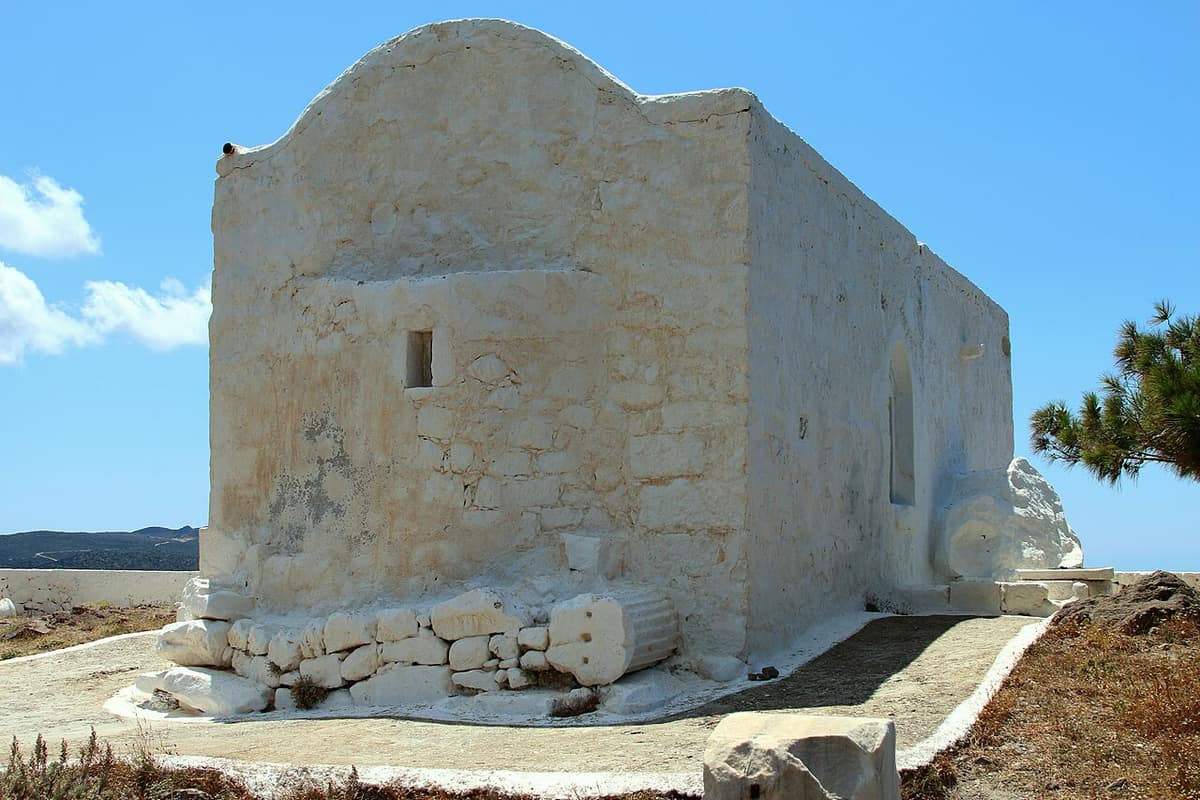
The sun sets in the west, so the hills of the west face it head on. On a Milos jeep tour, the group stops on a ridge with the sea ahead. No village stands in the way, and no building blocks the sky.
The west of Milos is rough, empty country. Villages are absent there, and only tiny settlements and old mines dot the land. The highest peak, Profitis Elias, is a dome of lava that set hard before it spread. Dirt tracks cross this empty land, and a 4×4 handles them.
From up there, the eye travels far. Antimilos, an island of volcanic rock with no one living on it, lies to the north-west. The rest of the western sky is open sea. As the light drops, the hills behind the group fade into layers of shade.
With no village near, little artificial light reaches the ridges. On a Milos jeep tour, the sky above the western hills turns dark, and the stars show clearly. This is the point where the group packs up and the drive down begins.
The drive down needs patience. Headlights light only a short stretch of track, and dust hangs in the beam. A 4×4 holds low speed on loose stone and keeps clear of the track edge. A Milos jeep tour takes the steep parts at walking pace.
- Direction: The western ridges face the setting sun.
- Horizon: Open sea fills the view, with Antimilos to the north-west.
- Ground: The high land is bare, so nothing blocks the sky.
- Light: Rock and sea change colour as the sun drops.
- Return: The way back is slow, with the headlights on.
A hilltop gives a fixed view of the sunset, while a boat gives a moving one. The sea view has its own page about a Milos sunset cruise. A Milos jeep tour suits those who prefer solid ground and a wide view over the empty west.

What is a picnic or barbecue stop on a Milos jeep tour?
A Milos jeep tour can pause for a picnic or barbecue stop. The meal is simple, eaten outdoors and made of local food. Water travels along, all litter goes back, and fire needs strict care in the dry season.
Greek cooking starts with olive oil, which goes into nearly every dish. Olives are widely eaten, and tomatoes are a main vegetable. Bread made from wheat is found everywhere. A picnic on a Milos jeep tour is built from these plain items.
Olive trees grow all over Milos, and barley is one of its main crops. Greek cooks use barley for paximadi, a traditional hard bread. A bag of olives and hard bread makes an easy meal on the hills.
A village salad starts with tomatoes, cucumber, onion and olives. Oregano and olive oil go on top. Greek cooks grill octopus and fish, and cook meat on skewers over charcoal. A barbecue stop on a Milos jeep tour follows the same habit of simple food cooked outdoors.
Water matters more than food on a dry hill. Milos has hot, dry summers, and the empty west has no village where a bottle can be bought. Each person carries enough water for the whole stop, and a spare bottle stays in the vehicle.
Dry grass lights easily, because it holds little water. The Mediterranean has long, hot, dry spells, and wildfires are common there. Campfires are one known human cause. Heat, low humidity and strong wind make a blaze spread faster.
- Water: Each person carries a full bottle.
- Litter: Wrappers, bottles and scraps go back in a closed bag.
- Fire spot: Cooking sits on bare ground, away from dry grass and shrubs.
- Ash: Coals are soaked with water and checked until cold.
- Wind: Strong wind is a reason to skip the fire.
A Milos jeep tour passes through protected land. The west holds over 800 kinds of living things, and 35 of them are found only in Greece. A clean stop and a full litter bag leave that land as it was found. A small fire, or none at all, keeps it safe.
How does a Milos jeep tour stay safe and comfortable off-road?
A Milos jeep tour stays safe when every rider wears a seat belt. Riders hold on over bumps. Dust, heat and rough tracks tire the body, so riders step out for air and shade at stops. Riders with back pain or carsickness choose with care.
A seat belt keeps a rider in the seat during a sudden stop or a rollover. On a Milos jeep tour, the belt goes on before the car moves. It stays snug, because a loose belt protects less. Back seats need a belt as much as front seats.
On a Milos jeep tour, off-road driving crosses unpaved ground such as dirt, gravel and rocks. The car lurches and drops on it. A rider keeps both feet on the floor and one hand on a handle. Bags rest on the lap, so a jolt cannot throw them around.
Dust is made of fine solid particles. Cars on dry tracks stir it up. Dust poses a health risk to children, older people and anyone with lung disease. A rider with breathing trouble can ask the driver to stay far behind the car ahead.
A car parked in direct sun heats up fast. When the air outside is 21 degrees Celsius, the air inside can pass 49 degrees. So riders step out into the shade at each stop. Light, loose clothes and steady sips of water help the body shed heat.
Motion sickness starts from a gap between actual and expected motion. On a Milos jeep tour, rough tracks can set it off. Eyes on the horizon and a still head help, while a phone screen makes it worse. A seat with a view of the road ahead helps too.
- Back: Shaking is linked to back pain, so a sore back suits a smoother tour.
- Pregnancy: Carsickness risk rises and back pain can start, so a doctor’s advice comes first.
- Migraine: Migraine raises the risk of motion sickness on rough tracks.
- Age: Children and older adults face more risk from heat and dust.
- Lungs: A rider with lung disease picks a tour with less dust.
In short, a Milos jeep tour stays comfortable with a snug belt and a firm hold. Water and shade do the rest. Riders with back pain, a pregnancy or lung disease can pick a smoother option. Travellers who plan to drive themselves can read more about driving in Milos.
What does a rider pack for a Milos jeep tour?
A Milos jeep tour calls for sunglasses, a scarf, closed shoes, a hat, sun cream and water. Swimwear and a towel join the list when the route reaches a beach. One small backpack carries it all. It keeps both hands free.
Dust and glare hit the eyes first on a Milos jeep tour. Sunglasses shield the eyes from bright sunlight. A thin scarf, kerchief or bandana over the nose and mouth guards the face from dust. The same scarf covers the neck against the sun.
Stops mean steps over loose stones and rough rock. Sandals leave the toes bare. Closed shoes with a firm sole protect the toes and heels from knocks. A firm sole also grips when a rider steps down from a tall car.
A hat with a brim shades the head, face and neck. Sun cream covers the skin the hat misses, and it goes on again after a swim. Sweat takes water from the body, so a full bottle goes along. Thirst, headache and tiredness are early signs of too little water.
Beach stops on a Milos jeep tour call for swimwear and a towel. Two shoulder straps on a small backpack keep both hands free to hold on over bumps. A zipped pocket stops the phone and keys from bouncing out. The towel keeps the seat dry.
- Eyes: Sunglasses must block ultraviolet light, the sun ray that harms eyes.
- Skin: Broad-spectrum sun cream covers both kinds of ultraviolet ray, UVA and UVB.
- Cover: A wide-brim hat and loose, tightly woven clothes also guard against sunburn.
- Feet: Closed shoes protect the feet and ankles on rough ground.
- Water: Drinking water fixes mild dehydration, the state of lacking body water.
In short, the pack for a Milos jeep tour stays light and simple. The eyes, nose, feet and skin each get cover. The body gets water. A swimsuit and a towel finish the list when the track ends at a beach.
How does a traveller choose a Milos jeep tour?
A Milos jeep tour is easy to choose with five checks. These are the tour length, the group size, the driver, the pickup point and the tour description. Each check answers one plain question. Together they show what the day holds.
The first check is the tour length. A half day covers one part of the island. A full day leaves time for more stops. A sunset tour climbs to a high point. There, daylight turns redder and softer before the sun goes down.
The second check is the group size. A small group shares one vehicle with other travellers. A private tour belongs to one party, so the party can ask for a longer stop. The tour description says which kind it is.
The third check is the driver. On a Milos jeep tour with a tour leader, the leader drives and explains the sights. On a self-drive rental, the renter drives and plans the route. A 4×4 is a vehicle that sends engine power to all four wheels.
The fourth check is the pickup point. A pickup comes from a hotel or from the port. A hotel pickup saves a walk with a bag. A port pickup suits a traveller who arrives by ferry. The fifth check is the written tour description, which lists five points.
- Vehicle: The type of 4×4 that carries the group.
- Route: The parts of the island that the tour crosses.
- Stops: The viewpoints, swim stops and rest stops, named in plain words.
- Seats: The seat count, and whether the vehicle is open or covered.
- Meeting point: The exact place of pickup and of drop-off.
Five lines of detail make an offer easy to judge. A traveller who finds them can set one offer beside another. Each line removes a guess before the day starts. Other ways to spend a day on the island are listed on the activities in Milos page.

Which questions come up before a Milos jeep tour?
A Milos jeep tour raises eight common questions. They cover children, driving, weather, swimming, photos, car sickness, luggage and boat days. Each answer below is short, plain and easy to read. It gives a first-time visitor one clear point.
Do children need car seats on a Milos jeep tour?
Children ride safest in a seat made for their weight and height. A child safety seat is built to protect a child in a crash. It works only when it is fitted the right way. Seat limits change from one model to the next. A tour description says if child seats are on board and in which sizes.
Can travellers drive themselves on a Milos jeep tour?
A self-drive 4×4 rental puts the traveller at the wheel. On rough ground, skill and experience matter more than a well-equipped car. Tests on wintery roads found that all-wheel drive helps with speeding up. It does not help with braking. Slow, steady driving suits a loose surface. An escorted tour hands that task to a tour leader.
What happens to a Milos jeep tour in rain or wind?
Rain falls in the mild winters, while summers stay warm and dry. Wet mud and clay give very little grip. A tour leader then drives slowly or picks another route. Strong, dry north winds blow on and off through the summer. They are strongest in the afternoon, and they can fade by night.
Do swimming stops fit a Milos jeep tour?
Swimming stops fit the day when the tour description lists them. Shores on Milos range from white sand to rocks shaped by the sea. Swimmers wear swimwear under their clothes. Rock shores call for shoes with a good grip. The tour leader decides on the day if the water is calm enough.
When are photo stops best on a Milos jeep tour?
Photo stops work best when the sun is low. In the golden hour before sunset, daylight is redder and softer. Midday sun makes harsh highlights and dark shadows. Low light also stretches shadows, which show the shape of hills and cliffs. The tour leader picks the lookouts, so the traveller only needs a charged phone.
Does a Milos jeep tour cause car sickness?
Car sickness starts when the eyes and the inner ear disagree about motion. Reading a map or watching a small screen makes it worse. Holding the head still and watching the horizon helps. Music and slow, steady breathing also help. A seat with a clear view ahead suits a sensitive traveller on winding tracks.
Where does luggage go on a Milos jeep tour?
A day tour calls for a small bag, not a suitcase. Space in the vehicle is limited, and loose bags slide on bumpy tracks. Suitcases stay at the hotel or in storage. A traveller who leaves the island that day asks the operator about a plan for bags. The answer comes before the day starts.
Can a Milos jeep tour join a boat day?
A land day and a sea day fit one holiday on the island. Both bring sun, wind and long days outdoors, so they work best on separate days. The 4×4 shows hills, mines and viewpoints. A boat shows the coastline from the water. The page on boat tours in Milos lists the sea options.