
Phylakopi is the ruin of a prehistoric town on the north shore of the island of Milos. People lived on this low headland through the whole Bronze Age, the era of bronze tools. Each new town rose on the ruins of the one before it.
With time, the waves have worn away a large share of the old town. Even so, the remains still show a massive wall of volcanic stone, a great hall and a shrine. Finds from the digs now fill display cases in museums in Athens and on the island itself.
What was Phylakopi and why does it matter?
Phylakopi was a Bronze Age town on the coast of Milos. It ranks among the key early sites of the Aegean, above all within the Cyclades. People lived there without a break through the 3rd and 2nd millennia BC, leaving deep layers behind.
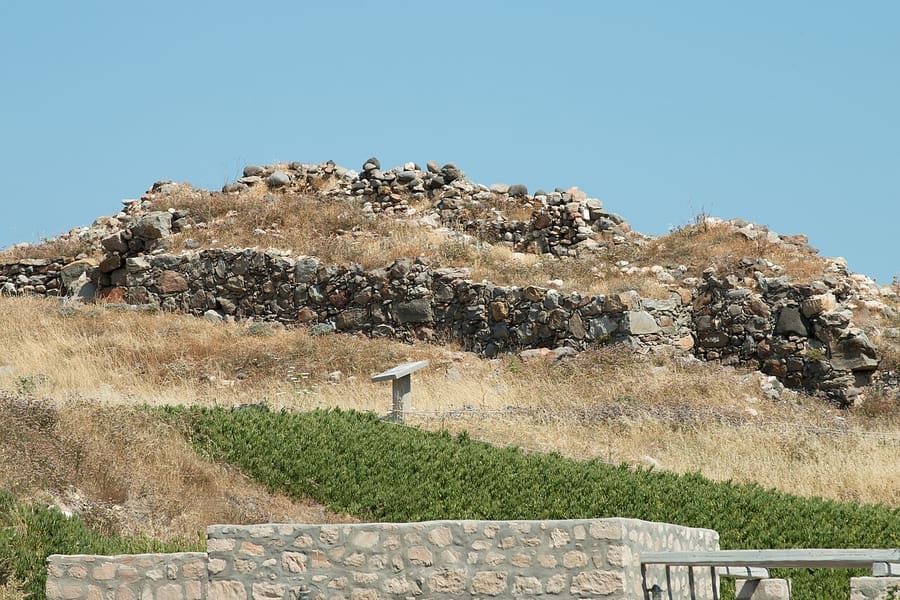
Because life at Phylakopi ran on with no long gap, experts treat it as a type-site. That term means a standard reference place, used to date finds from other sites. Stages of the Aegean Bronze Age are measured against the sequence of its layers.
The first settlers on the site were fishermen who caught tuna. Their village grew just as the mining of obsidian, a glassy volcanic rock, was in decline. In the centuries that followed, it turned into a true town with wide links across the sea.
In its final stage, Phylakopi had the look of a small city, with planned streets and drains. It covered about 27 stremmata, a Greek unit of land, and held at least 900 people. Experts see it as the central settlement of the whole island in that age.
Three remains stand out: a cyclopean wall, a shrine and the only megaron yet found in the Cyclades. Cyclopean means built of huge stone blocks, here of volcanic rock. A megaron is a great hall of the type found in the palaces of Mycenaean Greece.
Over time, Phylakopi took in ideas from abroad, in art as well as in building. Minoan Crete left a strong mark first, and Mycenaean Greece took the lead later on. The town was left empty at the close of the Bronze Age, and nobody settled there again.
- Type: It was a walled Bronze Age town on the shore of Milos.
- Region: Milos is the island furthest south-west in the Cyclades.
- Peak: It held at least 900 people in its final stage.
- Landmarks: A cyclopean wall, a shrine and a megaron hall survive.
- End: Nobody lived there again after the close of the Bronze Age.
In short, Phylakopi tells the whole Bronze Age story of the Cyclades within a single site. Its layers give experts a time scale for other digs across the Aegean. Its buildings and finds show an island town open first to Crete, then to mainland Greece.

Where does Phylakopi lie on Milos?
Phylakopi lies on the north-east coast of Milos, right beside the sea caves of Papafragas. Further east along the same shore, past two more beaches, comes the village of Pollonia. The founders picked a key spot for sea links with Crete and mainland Greece.
The town was built on a small rise that once ran out into the sea as a cape. A wide bay lay to its east, and the south end of that bay formed a sheltered cove. Today the bay has filled up with silt washed down from the land.
Waves have also cut into the old headland at Phylakopi. They dragged part of the cape, and part of the ancient remains, down into the sea. The town seen on the ground today is only a portion of the original.
On its western side, the site meets the narrow sea inlet of Papafragas, with its three caves. One sea cave there even lies within the bounds of the archaeological site. Ancient streets and sea-carved rock sit side by side on this short stretch of shore.
Along the north coast, the beaches run in a set order from west to east. Kapros comes first, then Papafragas, then the beach named after Phylakopi, then Kalogeros and Pelekouda. Pollonia, the smaller port used mainly for the link to Kimolos, ends the line.
A small modern settlement in the area also carries the name Phylakopi, taken from the prehistoric town. It stands about 10 metres above sea level and belongs to the community of Triovasalos. The 2021 census found only four residents living in the settlement.
- Coast: It sits on the north-east shore of Milos, close to the water.
- West: The three caves of Papafragas lie right beside the ruins.
- East: Kalogeros, Pelekouda and then Pollonia follow along the coast.
- Setting: The town hill was once a cape above a wide bay.
- Community: The area belongs to the local community of Triovasalos.
Phylakopi holds a strong position on the north coast of Milos. In the Bronze Age, it was a trading port between Crete and the Greek mainland. Today the same shore ties the ruins to Papafragas in the west and to Pollonia in the east.
What were the three towns of Phylakopi in the Bronze Age?
Phylakopi was rebuilt again and again on one small rise by the sea. Its ruins hold three towns, stacked one above the other. Each town matches a stage of the Bronze Age, the era when metal tools were made of bronze.
The story of Phylakopi starts before its first town. A small village stood right on the bare bedrock. Its clay pots match the Grotta-Pelos culture of the early Bronze Age. The first settlers made a living by catching tuna.
The first town with solid buildings is known as the First City. It grew larger through its whole life and lasted until close to 2000 BC. A dating label for the Cyclades, the Phylakopi I culture, is named after the town.
The Second City followed, from 2000 BC to 1550 BC. In those years the town grew into a major force in the Cyclades. Near the end, it was possibly the only settlement on Milos. It covered more than ten stremmata, a Greek land unit of 1,000 square metres.
Heavy damage, blamed on an earthquake, brought the Second City down. Around 1550 BC, a new town rose on the same ground. This was the Third City, and a strong wall guarded the neck of its cape.
The Third City passed through three smaller stages. Another way of counting splits it in two and names the final, Mycenaean stage Phylakopi IV. That last town covered an estimated 27 stremmata and held at least 900 people. It was abandoned at the end of the Bronze Age and never resettled.
- Labels: Experts number the towns Phylakopi I, II and III.
- First City: Its homes held hearths and storage bins.
- Second City: Its layers show plaster floors laid one over another.
- Third City: Its Mansion layers held ash from the eruption on Thera.
- Fill: About 0.9 metres of fill sealed the Mansion before a new hall rose.
Read from the bottom up, the layers of Phylakopi tell one long story. Fishers settled first, a town grew, an earthquake struck, and builders began again. Each new town rose on the remains of the one before. That is why the site still helps experts date the Aegean Bronze Age.
How did obsidian and sea trade shape Phylakopi?
Phylakopi grew on an island famous for obsidian, a black volcanic glass that breaks into very sharp edges. The stone made Milos known across the Aegean long before the town existed. Later, the town grew into a busy trading port.
Obsidian forms when lava flows out of a volcano and cools very fast. Crystals have almost no time to grow, so the rock sets as natural glass. It is hard but brittle, so it snaps rather than bends. Iron in the glass turns it dark brown or black.
A well-made obsidian edge is sharper than a steel scalpel. Early people broke flakes off a lump of the glass, a skill called knapping. These became small knives, blades, arrowheads and spear points. Around the eastern Mediterranean, it also became mirrors and ornaments.
Thanks to its fine quality, Milos obsidian was the favourite tool stone of the prehistoric Aegean. The sources lie on two hills in the east of the island, Nychia and Demenegaki. Their slopes are scattered with thousands of leftover cores and blades, plus millions of waste chips.
Milos obsidian travelled far, even before farming began. Its oldest proven find away from the island comes from Franchthi Cave in the Argolid. Pieces reached as far as Knossos in the south and Nea Nikomedeia in Macedonia. An X-ray test of the stone tells whether a piece came from Milos, Nisyros or Gyali.
Milos lies between mainland Greece and Crete. That spot, plus its obsidian, turned the island into a key centre of the early Aegean. Its people shaped the stone with skill, shipped it abroad and prospered more than nearby lands. Phylakopi rose later, just as quarrying was in decline.
- Quarry trips: Early seekers beached boats in coves and cut glass from the quarries.
- Boat test: A modern pine-log boat sailed from Ermioni to Milos and back.
- Early contacts: The first town shows influence from two other cultures, Keros-Syros and Lefkandi I.
- Trade partners: Finds from Phylakopi point to links with Crete and Thera.
- Wide reach: Milos obsidian knives and arrowheads reached the Peloponnese, Crete and Egypt.
Once bronze became the metal of choice for weapons, the island’s old advantage faded. Even so, obsidian and pottery kept moving by sea in the Bronze Age. Phylakopi became a port between Crete and the mainland, with contacts in both worlds. Its jugs decorated with birds even reached Knossos.
What links Phylakopi to Minoan Crete and Mycenae?
Phylakopi shows strong ties with two powers of the Bronze Age. Styles from Minoan Crete came first and spread through its pottery, rooms and writing. Later, influence from Mycenae on the Greek mainland took over, with a palace-style hall and Mycenaean pots.
Minoan culture grew up on Crete, south of the Cyclades, during the Bronze Age. Contact with the islands ran both ways, and Cycladic pottery once left its mark at Knossos. Late in the Second City, more and more Minoan pots turned up at Phylakopi. That shift is called Minoanisation, the spread of Cretan styles.
In the early Third City, builders borrowed Cretan ideas. Square limestone pillars in one large complex resemble pillars from the palace age of Crete. Five bowls on stands, pierced with holes, sat at the foot of a column. On Crete, such bowls served for pouring drink offerings.
Part of a clay tablet in Linear A lay in a building known as the Mansion. Linear A is one of two Minoan scripts, and nobody can fully read it today. The find suggests the town was run on the Minoan model.
Heavy Minoan influence led to the idea that Crete ruled Phylakopi. Another view says Minoan styles were a status fashion among rich Aegean families. A painted fragment showing a blue monkey’s eye adds to the link. In that age, monkey images are known elsewhere only from Knossos and Thera.
After the Thera volcano erupted, Crete’s pull weakened and Mycenaean pottery began to appear. In the early 14th century BC, builders added a megaron, the throne hall of Mycenaean palaces. Its plan, with an entrance room and a large hall, matches the mainland model. It remains the only one known in the Cyclades.
- Cretan lamp: The pillar rooms held an imported soapstone lamp from Crete’s palace age.
- Room plan: Doors led straight into column rooms, a type common on Crete and Thera.
- Fresco link: The flying fish painting resembles Minoan art, possibly by a Cretan painter.
- Shrine figures: Mycenaean clay figures stood in the East and West Shrines of Phylakopi.
- Fire: Part of the town burned while Mycenaean power spread across the Aegean.
One reading says Mycenaeans took over Phylakopi and installed a governor. Another sees islanders simply adopting mainland ways. Local Cycladic pottery styles almost vanished in this last phase. The wider history of Milos follows the island long after these Bronze Age towns.
How were the walls and houses of Phylakopi built?
Phylakopi was guarded by a strong stone wall across the narrow neck of its headland. Behind it, rectangular stone houses stood in neat blocks along straight streets. The plan grew over time, from a crowded early town to an ordered final one.
Even before the great wall rose, the houses of Phylakopi stood close together on the low hill. In the second town, during the Middle Bronze Age, homes were packed into tight blocks. Long, straight streets divided one block from the next and crossed the settlement.
That second town kept spreading until it covered more than 10 stremmata of land. By the close of that age, it was possibly the one town left on the island. An earthquake is thought to have caused its wide ruin, and a new town rose on top.
The wall of Phylakopi went up at the start of the Late Bronze Age. It ran across the thin strip of land that tied the headland to the rest of Milos. Its volcanic blocks had five or more angled faces, a style called polygonal masonry.
The outer face of the wall was toothed, so it stepped in and out along its length. Walls of such huge stones are called cyclopean, the oldest kind of polygonal walling in Greece. The classical Greeks believed that only the giant Cyclopes were strong enough to lift them.
Early in the 13th century BC, the defences of Phylakopi were strengthened, rebuilt and pushed further out. Behind them, the last town had rectangular stone houses set in blocks. Its street grid followed north, south, east and west, and a drainage system took waste water away.
- Hearths: The earliest homes held hearths and storage bins.
- Doors: Front doors of ordinary houses opened directly onto the streets.
- Public court: Only one large public court is known from the second town.
- Big building: The Pillar Rooms covered about 21 by 13 metres in the second town.
- Stonework: Its wall facing the court was partly built of stones shaped with a hammer.
The walls and houses of Phylakopi show a town that grew in clear steps. A crowded early plan gave way to a walled town with ordered blocks, streets and drains. The shrine of the last town was added when its eastern quarter was rebuilt.
What did the shrine of Phylakopi hold?
The shrine of Phylakopi was a public place of worship inside the town, rare in the Aegean then. Its rooms held clay figures of gods and gifts for them. The best known is a tall female figure, the Lady of Phylakopi.
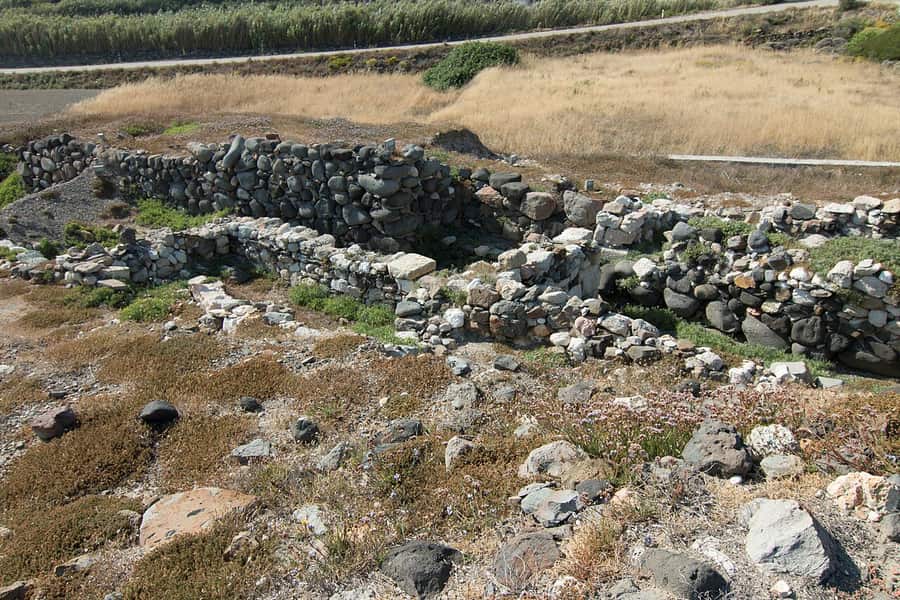
The people of Phylakopi built their shrine early in the 14th century BC, in the last town. It stayed in use through three main phases, with repairs and changes along the way. The community came here to worship, to make sacrifices and to leave offerings.
The oldest part was the West Shrine, a main room of 5.8 by 6 metres. Two side rooms lay to its west, sized 1.6 by 1.6 metres and 3.8 by 1.6 metres. The East Shrine came later, at about 7 by 4 metres, and faced a different way.
No part of the roof has been found, but central pillars are thought to have held it up. Inside the West Shrine stood a raised platform for an altar. Groups of niches, meaning small recesses in the walls, also point to rituals held here.
The Lady of Phylakopi dates from the 14th century BC and was found in the West Shrine. Experts read her as a goddess or a priestess. At 45 centimetres, she towers over the small Mycenaean clay figures of her age.
Those small figures, called psi and phi after Greek letters, stood 10 to 20 centimetres high. Big wheel-made clay figures like her are much rarer, with others from Mycenae and Tiryns. The Lady is now kept in the archaeological museum of Milos, in Plaka.
- Male figures: Unusual male figures with boldly shaped bodies are thought to show male gods.
- Later gods: They hint at the twelve Olympian gods of later Greek times.
- Offerings: A large group of small statues was made as gifts to the gods.
- Collapse: Late in the Bronze Age, heavy damage struck the whole complex.
- End: After a period of reuse, the shrine was abandoned for good.
The shrine of Phylakopi shows, in one place, how the townspeople honoured their gods. Its altar platform, its niches and its clay figures all served the same rites. Wall paintings of nature and sea life, along with stone altars, were also found in its rooms.

What painted pottery and frescoes were found at Phylakopi?
Phylakopi has given painted pots and wall paintings from across its long life. Local potters decorated their vessels with plants and animals in dull black and red. Later, painted plaster walls showed flying fish, lilies and a blue monkey, close to the art of Crete.
The first village at Phylakopi used pottery of the Grotta-Pelos culture. That early Cycladic culture takes part of its name from Pelos, a site on Milos itself. In the second town, local wares included Dark Burnished ware, polished before firing, and Cycladic White.
Decoration showed plants and animals in matt black and red, meaning a dull finish without shine. The best-known pieces, the Melian bird jugs, travelled as far as Knossos on Crete. Late in that town, Cretan pots reached Phylakopi in growing numbers.
The richest group of wall paintings came from the Pillar Rooms, a large building with stone pillars. Nearly all the painted pieces lay face down on the floor. Certain thin, decayed pieces were curved, as if they had edged the top of a wall.
A fresco is painted on fresh, wet lime plaster, so the colour joins the wall as it sets. Secco is paint laid on plaster that has already dried. The painters at Phylakopi used both methods on long painted bands called friezes.
The famous flying fish fresco shows two rows of fish, one above the other. In the upper row, the fish glide through the air with fins spread like wings. Below, they cross the surface of the water with folded fins, among bubbles and spray.
- Real fish: Flying fish do not truly fly but glide on long, wing-like fins.
- Lilies: White lilies with yellow tips run along a red band with a black base.
- Rosettes: Red, blue and black rosettes, or round flower shapes, sit on a white ground.
- People: Scenes show a woman with blue cloth and a woman with hands held out.
- Monkey: A single piece of plaster keeps the eye of a blue monkey.
The pots and paintings of Phylakopi follow the changing taste of the town over time. Its potters first painted plants and animals in a local island manner. Later, wall painters brought the sea indoors with gliding fish, close to the work of Cretan artists.
How was Phylakopi dug, from the first British seasons to the 1970s?
Phylakopi was dug by the British School at Athens, a British research institute founded in 1886. Its first team worked there from 1896 to 1899. A second season followed in 1911, and a third team came from 1974 to 1977.
The British School was the fourth foreign school of archaeology in Greece. The French, German and American schools came first. Its first team found a Bronze Age town of the Cyclades that nobody had known before. People lived there from the Early Bronze Age to the very end of the Late Bronze Age.
Duncan MacKenzie, later a foreman for Arthur Evans at Knossos, noted each soil layer in detail. Archaeologists call this stratigraphy, the study of layers laid one above another. His method was well ahead of its time. It gave Phylakopi a clear order of three phases, one town above the next.
The 1911 season came back to sort the pottery into a finer order of dates. Its team also found eight child burials under the earliest houses. Each lay in a pithos, a large storage jar, set in a shallow hollow in the bedrock. The oldest children were starting to get their second teeth.
In the summer of 1974 the British School returned to Phylakopi. That campaign uncovered a shrine that had been unknown until then. A trench under the megaron, the great hall of the final town, reached an older building. Archaeologists call that earlier building the Mansion.
A layer of fill about 0.9 metres deep had sealed the plaster floors of the Mansion. The later hall stood on top of that fill. A broken clay tablet written in Linear A also came from the Mansion. Samples from its layers also held tephra, the ash thrown out when Thera erupted.
- Type-site: The site is a reference point for dating stages of the Aegean Bronze Age.
- Infants: The 1974–75 seasons found three more infant burials under house floors.
- Pillar: A pillar in the East Pillar Room was pushed over after its discovery.
- Repairs: Greek and British teams have both strengthened the ruins.
- Publication: The results of the 1974–1977 seasons appeared in a 2007 volume.
Each campaign at Phylakopi asked new questions of the same ground. The first found the town and set out its layers. The second refined the pottery dates. The third tested older ideas with new trenches and ash samples. It also found the shrine.
Where are the finds from Phylakopi kept today?
Finds from Phylakopi sit mainly in two Greek museums. Objects from the digs of the 1890s went to Athens, to the National Archaeological Museum. Later seasons left their finds on Milos itself, in the island’s Archaeological Museum at Plaka.
The National Archaeological Museum stands on Patission Street in central Athens. Work on its building began in 1866 and ended in 1889. Its prehistoric collection runs from the Neolithic era to Cycladic and Mycenaean art. The finds of the first digs at Phylakopi are on show there.
The famous flying fish fresco is also in Athens. It came from the ruins of the Pillar Room. Experts rebuilt the frieze from small broken pieces into two panels. The painter drew the fins like wings, so the fish look almost like birds.
Both fish panels have smooth, flat edges. One theory says they were painted at Knossos on Crete. Then they were set in wooden frames and shipped out ready-made. On Thera, friezes of this small size were placed at about eye level, beside windows or doors.
In Plaka, the second room of the Milos museum covers the island’s Bronze Age. Its cases hold objects from Phylakopi and other sites, in Early Cycladic, Minoan and Mycenaean styles. Pieces from the town include a red-painted goblet and a pithos. A bathtub and part of an offering table also come from there.
The museum also keeps the Lady of Phylakopi, a clay figure 45 centimetres tall. It was shaped on a potter’s wheel and found in the West Shrine. It shows a goddess or a priestess and carries the catalogue number B 655.
- Oxford: The Ashmolean Museum holds fine pieces from Phylakopi.
- London: The British Museum shows a duck-shaped vase, or askos, from the first town.
- Kernoi: Two clay kernoi from the same site are also kept in London.
- Collections: The Plaka museum shows prehistoric finds, sculpture, obsidian and inscriptions.
- Architect: Ernst Ziller designed the Plaka museum and helped revise the Athens museum plans.
A full view of Phylakopi therefore takes two museum visits. Athens shows the fish fresco and the finds of the first digs. Plaka shows the pottery and the Lady from the later seasons. Together with the ruins, the two collections tell one story.
What can visitors see at Phylakopi today?
Phylakopi today is a field of stone remains on a small rise by the sea. Three features stand out on the ground. They are the heavy town wall, the shrine area and the megaron, a large hall. Firm shoes and drinking water make the walk there easier.
The ruins lie beside the road to Pollonia, on the left for drivers heading that way. This is a guarded archaeological site, so staff keep watch over the ancient remains. The old town covers a small hill at the water’s edge on the north coast of Milos.
Three main remains give a walk around Phylakopi its basic shape and order. The first is the town wall, a strong barrier of big volcanic blocks against attackers. Next come the shrine, a place of worship, and the megaron, a hall in Mycenaean palace style.
The visitor area at Phylakopi took its present form between 2003 and 2008. The Ephorate of Antiquities of the Cyclades, a state office for old sites, did that work. Both the Archaeological Service and the British School at Athens have made repairs to keep the remains firm.
Ancient ruins mean uneven ground, with loose stones and low edges between levels. Shoes with a firm grip suit this kind of surface far better than thin sandals. Visitors at Phylakopi treat the old walls as things to look at, never as seats or steps.
The small hill stands open to the sky, so planning for full sun makes sense. A hat, sun cream and drinking water belong in every bag for a ruin like this. A morning visit keeps the walk away from the strongest heat of a summer day.
- Wall: Big blocks of volcanic stone form the town’s old defensive wall.
- Shrine: This area was the public place of worship for the whole town.
- Megaron: This large hall is the only known example in the Cyclades so far.
- Finds: Objects dug up here are on show in museums in Athens and on Milos.
- Footing: Firm shoes help on the uneven stone and earth of the site.
A visit to Phylakopi works best with the three main remains in mind. The wall, the shrine and the megaron give the walk a clear and simple order. Good shoes, water and a hat take care of the practical side of any visit there.
What is the coast around Phylakopi like?
The coast around Phylakopi has changed a great deal since the Bronze Age. The town stood on a headland beside a bay that has now filled in. The sea has also taken part of the ruins. Papafragas lies next door, with Pollonia farther east along the shore.
The small hill under Phylakopi was once a headland, a point of land reaching into the sea. A wide bay opened to the east of this point. The southern end of that bay formed a small cove, sheltered from the waves of the open water.
That bay no longer exists, because silt, the fine earth carried by water, has filled it. Erosion has also worn away part of the headland at Phylakopi over time. The sea then carried part of the ancient remains away along with that lost land.
Not every part of the old town has suffered from the sea in the same way. One large building, the Pillar Rooms Complex, has stayed intact despite the erosion. Its high spot on the central ridge, at the heart of the town, kept it safe.
Papafragas, the next spot to the west, is a sea inlet framed by grey and white rock. Three sea caves open there, right next to the ancient ruins of Phylakopi. Its turquoise water runs between the pale rocks and flows out towards the open sea.
To the east, the shore runs past the beaches of Kalogeros and Pelekouda. The main road also heads downhill to the north-east and ends at the harbour village of Pollonia. A small boat leaves from there on a regular link to the nearby island of Kimolos.
- Headland: The ruins sit on a small hill that once pushed into the sea.
- Bay: Silt now fills the wide bay that lay east of the town.
- Erosion: The sea has carried away part of the old town.
- Cedars: Single cedar trees dot the inland route towards the site.
- Papafragas: Three sea caves open in the rocky inlet beside the ruins.
The shore at Phylakopi shows how land and sea keep changing over time. A bay has filled with silt, and the waves have taken part of the headland. Papafragas to the west and Pollonia to the east frame this part of the north coast.
When is the best time of year for a visit to Phylakopi?
Phylakopi is easiest to explore in spring and autumn, when days are mild and rain is light. Summer brings hard sun to open ground beside the sea. Winter stays mild, yet rain returns on more days and the ground stays damp.
The weather on Milos follows the Mediterranean pattern. Winter brings rain and gentle cold. Summer is dry, and it turns from warm to hot. The ruins sit on a low hill by the north coast that was once a small cape. Little stands between that open ground and the sun.
Summer is the hardest season for a long walk at Phylakopi. July is the hottest month, with daytime highs of 28.1 °C and nights near 21.8 °C. June holds the island record of 44.0 °C. Rain all but vanishes, with just 0.3 mm in an average July.
Spring brings softer conditions. April averages 18.4 °C by day and 12.4 °C at night. Rain falls on about three days that month. Highs climb toward 23 °C before summer arrives. Clear, mild mornings suit a slow look at the walls and the plan boards on site.
Autumn holds its warmth for a long time. September highs average 25.2 °C, and the month stays almost dry. October highs drop to 21.3 °C, with rain on about four days. Winter is the wet season. December collects 90.3 mm of rain, and nights in January and February average 8.5 °C.
- Spring: April days near 18 °C keep the walk around the walls cool and easy.
- Summer: Highs above 27 °C from June to August make an early start the safer choice.
- Autumn: September stays warm and dry, and October brings the first steady rain.
- Winter: Rain peaks in December at 90.3 mm, so the soil on the hill stays soft.
- Kit: Water and firm shoes suit every season, and a hat joins them from spring to autumn.
For a visit to Phylakopi, April and September give the best balance of warm air and dry ground. July and August suit only an early start with plenty of water. Winter fits a short, quiet look between showers, with a waterproof layer close at hand.

Which nearby sights combine well with Phylakopi?
Phylakopi lies on the road to Pollonia, so one north-coast drive links it with other stops. The sea caves of Papafragas sit right beside the ruins. Sarakiniko, Pollonia, the museum in Plaka and the ancient theatre complete the list.
Papafragas sits next to the ruins of Phylakopi and holds three sea caves. The main one is a deep sea cave. Turquoise water runs through it, between grey and white rock. A steep cut in the rock leads down to a small beach. Pirates used the spot as a base in Byzantine times.
Sarakiniko lies on the same north shore. North-wind waves have carved its pale grey volcanic stone into odd shapes. Islanders liken the view to the moon’s surface. Its name recalls the pirates who once sheltered there. A separate page on Sarakiniko beach covers the swim and the rock forms in detail.
About 300 people live in Pollonia, a fishing village. It wraps around a small cove at the north-eastern tip of Milos. Each morning, local boats return to the pier by its church. They bring in fish, octopus and lobster. The name is thought to come from a temple of Apollo near the lighthouse.
Plaka, the main town, holds the Archaeological Museum of Milos. It fills a neoclassical building from 1870 on the main square. Its prehistoric collection comes from the old town on the north coast. Clay pots, figurines and a broken clay tablet with Linear A writing are on show there.
Between Trypiti and the seaside village of Klima, the ancient theatre fills a slope. The old city of Milos once lay there. Its rows of marble seats belong to a far later age. The prehistoric site was already deserted long before that city rose.
- North coast: Phylakopi, Papafragas and Pollonia line one road and fit a single outing.
- Swim stop: Papafragas offers a dip in a sea cave right beside the ruins.
- Rock scenery: Sarakiniko adds pale volcanic shapes on the same north shore.
- Museum: The museum in Plaka shows objects dug up on the hill.
- Later history: The theatre near Klima shows the city that came long after.
A day that pairs Phylakopi with Papafragas and Pollonia keeps the driving short. The museum and the theatre fit a second, slower day in the hills around Plaka. Beaches, boat trips and hikes sit among the other activities in Milos.
What do visitors want to know before seeing Phylakopi?
Phylakopi raises eight common questions before a first visit. They cover the age of the town and the ruins still on show. Children, shoes, shade and photos come next. The last two deal with the road there and the museums that keep the finds.
How old is Phylakopi?
The town dates from the Bronze Age. People lived on the hill without a break through the third and second millennia BC. That long, unbroken record makes it one of the key Bronze Age towns of the Aegean. At the close of the Late Bronze Age, the town was left empty and never lived in again.
What is left to see at Phylakopi today?
Three remains stand out on the hill. The first is the massive town wall, built from large volcanic blocks. The second is the shrine area. The third is the megaron, a great hall like those in mainland Greek palaces. The sea has carried off a large part of the town. Boards with plans explain the rest.
Is Phylakopi a good outing for children?
Plan boards help children trace the old streets and houses. Sharp black chips of obsidian, a glassy volcanic stone, lie on the ground. Small hands leave them alone. The sea has eaten into the hill, so children stay back from the edge. Afterwards, the museum in Plaka shows a clay toy horse from ancient Milos.
Which shoes suit a walk at Phylakopi?
Closed shoes with firm soles work best. The ground holds sharp chips of black obsidian, waste from ancient work on the stone. Open sandals let those chips reach the skin. A side trip to Papafragas next door adds a steep cut in the rock. Good grip matters even more on that way down to the water.
Is there shade at Phylakopi?
Shade is scarce. Milos is a dry island with only thin plant cover. The ruins lie on an open hill by the sea. From June to August, daytime highs pass 27 °C, and rain almost never falls. A hat, sun cream and a large bottle of water make the walk easier. An early start helps too.
What makes a good photo at Phylakopi?
The wall of huge volcanic blocks gives the clearest subject. The worn rim of the old cape, cut back by the waves, makes a second frame. Next door, Papafragas adds turquoise water between grey and white rock. Sarakiniko, on the same coast, counts among the top photographed landscapes in the whole Aegean.
How do visitors reach Phylakopi?
Drivers bound for Pollonia pass the ruins on their left, right beside the road. From Adamas the drive to Pollonia covers roughly 10 km; from Plaka it is about 14 km. The site comes before the village on that drive. City buses serve parts of Milos, with more frequent routes in summer. Taxis wait at the harbour and the airport.
Where are the best finds from Phylakopi kept?
Objects from the first digs, in the 1890s, were taken to Athens, to the National Archaeological Museum. The flying fish wall painting is on show there. Finds from the later digs stay in the Archaeological Museum of Milos in Plaka. Among them is the clay goddess figure known as the Lady of Phylakopi, found in the shrine.