Coffee and drinks in Zefiria, Milos: see our Coffee – Drinks in Milos section for the island.
Zefiria is a farming village in the inland east of the island of Milos, which lies in the south-west of the Cyclades. This page treats coffee and drinks in Zefiria as part of village life, among fields, church walls and a road that runs on towards the south-east coast. The village counts 190 residents, so a cup or a glass is a small, local pause.
Two sections follow. The first sets out coffee and drinks in Zefiria at a glance: where the village lies, how its farming character frames a stop, and where a cup or a glass fits into a visit. The second turns to the village centre and daily life. The old capital, the feast, the fields and the paths come later.
What stands out about coffee and drinks in Zefiria at a glance?
Coffee and drinks in Zefiria belong to an inland farming village in the centre of east Milos, on the road from the port to the south coast. A cup or a glass fits the pause between the fields, the churches and the sea.
Coffee and drinks in Zefiria begin with the setting. The village stands in the centre of east Milos on low ground at 10 metres, while Trypiti, the community it belongs to, climbs to 150 metres on the rise above Adamantas that also carries Plaka and Triovasalos. The port holds 1,268 residents against 190 in Zefiria. A traveller who expects a quay lined with tables meets a small inland settlement instead, with fields in place of a waterfront.
The farming character comes first. Zefiria is a lively rural settlement, and agriculture sets its character. Milos as a whole is too dry for a profusion of vegetation, and grapes, cotton and barley are its main crops. Olive, orange and cypress trees grow across the island. Farmland fills the ground around the houses. In such a place a coffee or a drink is a pause inside a working day. Coffee and drinks in Zefiria suit that pause: short, local and close to the land.
The road explains how a visit is built. Past the village, the way continues to the beaches of Agia Kyriaki and Paleochori, which belong to the same community of Trypiti as Zefiria. Agia Kyriaki lies about 10 kilometres south-east of Adamantas and 13 from Plaka, and Paleochori about 14 and 13. Zefiria, at 5.5 kilometres from the port, sits before both. Coffee and drinks in Zefiria therefore break the run between the harbour and the sea.
The old Greek café sets the pattern for coffee and drinks in a village of this kind. A kafeneio serves Greek coffee and frappé, along with beer, retsina and ouzo. Meze or free snacks come with the drinks, and full meals are rare, so the room is for sitting and talking rather than dining. Kafenia were family businesses, simply furnished, and their walls are frequently whitewashed. That plain setting belongs to the tradition behind coffee and drinks in Zefiria.
- Place: Zefiria stands inland in the centre of east Milos, 5.5 kilometres from Adamantas and 9 from Plaka.
- Height: The village lies at 10 metres, and Trypiti above the port reaches 150 metres.
- Size: The census of 2021 counted 190 residents in Zefiria and 1,268 in Adamantas.
- Road: The way through the village leads on to the beaches of Agia Kyriaki and Paleochori.
- Character: Zefiria is a lively farming settlement, with fields around the houses.
At a glance, coffee and drinks in Zefiria are those of an inland farming village: 190 residents, low ground, fields all around and a road that carries traffic on to the south coast. The page on coffee and drinks across Milos places the village beside the port and the other settlements. The next section looks at the village centre and at daily life.

How do coffee and drinks in Zefiria fit daily life in the village centre?
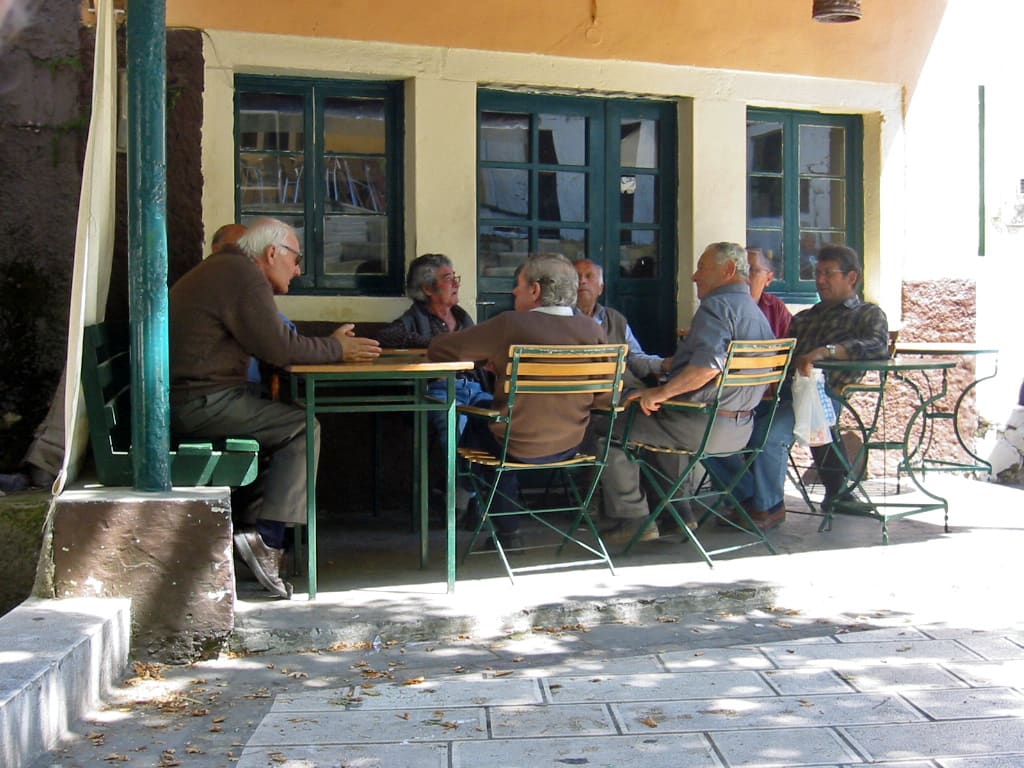
Coffee and drinks in Zefiria follow the daily life of a farming village of 190 people, with the old cathedral in the centre. The kafeneio, the old Greek café, has long served such villages as a social room, where neighbours talk after work and play cards.
The centre of Zefiria is a church. The old cathedral of Panagia Portiani stands in the middle of the village and is the only church that survives from the old Chora of the settlement, the town that once led the whole island. Around it the village is small, with only 190 residents in all. Coffee and drinks in Zefiria belong to this compact core, where the cathedral and its bell tower mark the middle of the settlement.
The kafeneio gives a village its social room. The word comes from the Turkish kahvehane, itself from the Persian qahveh-khaneh, a house of coffee. In Greece kafenia serve as social centres of the villages and islands where they stand. People meet after work, talk and play a game of cards. Women were not welcome in earlier centuries, but girls and women now frequent kafenia as well. Coffee and drinks in Zefiria carry that inherited role, where the cup is the occasion and the company is the point.
Daily life in a farming village also happens outdoors. In yards, at kafenia and in gardens, capers dry in the sun and tomatoes are picked. Capers grow in abundance on the rocky soils of the island, are collected by hand and are set in vinegar or salt after drying. The tradition of Milos ties this produce to nature and to the self-sufficiency of its inhabitants. Coffee and drinks in Zefiria sit beside that work, not apart from it: the yard and the table belong to one day.
The size of the village shows in its census. The count of 1951 gave 409 residents, and the count of 2021 gave 190, fewer than half. After the earthquakes of the 18th century much of the population moved towards the port, and Zefiria kept the fields. The village is small, and its daily rhythm follows the plain: the work of the farms and the pause for a cup or a glass. Coffee and drinks in Zefiria fit that rhythm.
- Centre: The cathedral of Panagia Portiani stands in the middle of the village.
- Survivor: It is the only church left from the old Chora of the settlement.
- Social room: The kafeneio serves villages and islands as a social centre.
- Pastime: Neighbours meet after work and play a game of cards.
- Census: The village counted 409 residents in 1951 and 190 in 2021.
In the village centre, coffee and drinks in Zefiria are part of ordinary life: a cathedral in the middle, a kafeneio tradition of talk and cards, yards where capers dry and a settlement of 190 people. The visit stays small and local. The later sections turn to the old capital, the August feast and the farmland that surrounds the houses.
How does the old capital of Milos shape coffee and drinks in Zefiria?
Coffee and drinks in Zefiria belong to a village that Venetian rule created, pirate raids helped make the capital of Milos, and earthquakes and epidemics drove its people away in 1767. A small farming settlement stands on that ground, and Plaka now holds the rank of capital.
Anyone ordering coffee and drinks in Zefiria sits in a village whose story starts with the Fourth Crusade. In 1204 a Venetian lord seized Milos and joined it to the Duchy of Naxos. The first dynasty of the duchy ruled the island until 1361, and a second dynasty followed until 1566. Both ruling families were Catholic, while the majority of the islanders were, and still are, Greek Orthodox. The first Catholic bishop of Milos was appointed in 1253.
Pirates shaped the next chapter. Under the second dynasty of the duchy Milos became a stronghold of pirates, and Venice was unable to control the raids. The village flourished in that age and became the capital of the island. Zefiria stands inland, in the centre of East Milos, beside its large plain. Today coffee and drinks in Zefiria belong to a settlement away from the harbour of Adamantas, where much of the population of the old capital settled.
In 1566 the Venetians handed the duchy to the Ottoman Empire, and in 1579 the Ottomans annexed it formally. In the early 18th century the population of Milos passed 6,000 and was almost entirely Greek and Christian. A Turkish judge and a Turkish governor held authority, three elected magistrates ran daily affairs, and the island kept two bishops, one Greek Orthodox and one Latin Catholic. This was the island that stood behind coffee and drinks in Zefiria in the decades before the village was left.
The end came in 1767. Earthquakes destroyed the village, and epidemics caused by gases from cracks in the ground added to the damage, so the inhabitants relocated. The present settlement of Plaka grew out of that abandonment. Plaka took its name from the flat ground where houses rose when the Kastro ran short of room. Zefiria was also called Chora, and for that reason Plaka is not called Chora. Coffee and drinks in Zefiria therefore belong to the place that held the old name of the island’s main town.
- Duchy: The Duchy of Naxos took its name from the island where its capital stood.
- Pirates: A pirate occupied the island itself in 1537, before the Ottoman takeover.
- Appeals: Appeals against decisions of the three elected magistrates went to the Turkish judge.
- Autonomy: The islanders enjoyed a great degree of autonomy, yet they found the Ottoman taxes heavy.
- Russians: Turkish rule ended in 1770 when the Russians appeared in the Aegean, and the Ottomans restored it later.
Zefiria lost the title, the court and the crowds, yet it kept the plain, the name Chora and a place in the memory of Milos. A visit for coffee and drinks in Zefiria is a visit to the former capital, where the Venetian lords, the pirates and the Turkish judge have all gone. The village of Zefiria remains on the plain that carried all those centuries, and coffee and drinks in Zefiria are served there today.
What do Panagia Portiani and the 15 August feast add to coffee and drinks in Zefiria?
Coffee and drinks in Zefiria sit beside Panagia Portiani, the old cathedral of Milos and the only church left from the old town, and beside the 15 August feast, one of the leading festivals of the island, held in memory of the Virgin Mary.
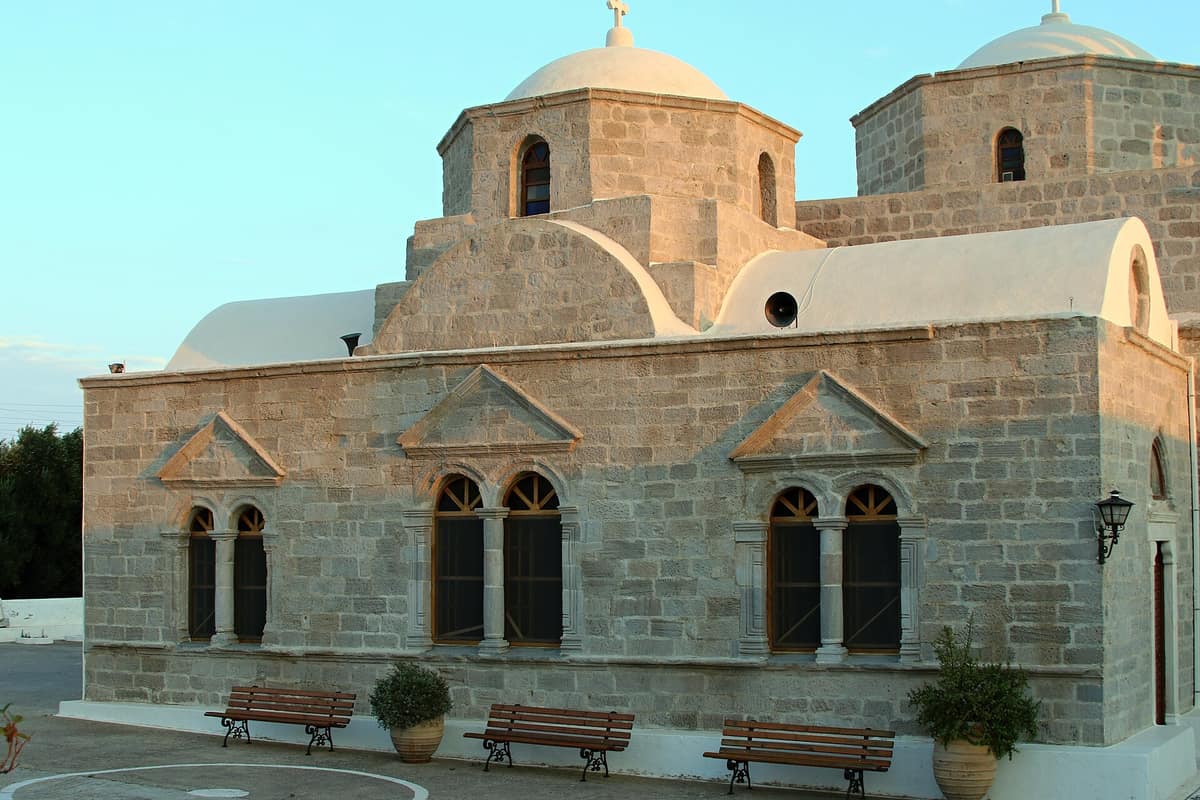
Panagia Portiani, also called Portaitissa, stands in the centre of Zefiria, the village that was once the Chora of Milos. The church was the old metropolis of Milos and is the only church that survived from the Old Chora of the village. It shares a wall with the church beside it. An inscription places the building before 1576, and its exact date is not known. A stop for coffee and drinks in Zefiria is a stop in the middle of the Old Chora.
The name Portiani is linked to the gate of the castle that stood near the church. An earthquake of the 18th century, in the years of Ottoman rule, destroyed the town and left the church deserted. In 1864 the icon of Panagia Portiani, other historic icons and parts of the rich interior decoration were moved to the new church of the Dormition in Adamantas, also called Agios Charalampos. Coffee and drinks in Zefiria today sit in a village whose old church treasures went to the port.
The feast of 15 August is the Dormition of the Virgin, which marks the falling asleep of Mary and her being taken up into heaven. It follows a fast. From 1 to 14 August the Orthodox keep a fast from red meat, poultry, dairy products, fish, oil and wine. The Transfiguration on 6 August allows fish, wine and oil. The feast in Zefiria comes after the last day of that fast, so coffee and drinks in Zefiria on 15 August belong to a festival day.
At the panigyria of Milos, the traditional festivals of the island, the dishes include skoufomakarono, a traditional pasta with myzithra cheese and browned butter, and lemonato, goat cooked with lemon. Everything on the island table is cooked with simplicity, in a craft handed down from generation to generation. Wine production has revived in recent years, and local winemakers make wines that reflect the volcanic soil. The feast in Zefiria is one such panigyri, and coffee and drinks in Zefiria belong to the same island table.
- Protection: The church is a listed monument under the 2nd Ephorate of Byzantine Antiquities.
- Interior: Old wall paintings and other relics are kept inside the church.
- Sweets: Milos koufeta are small almond sweets covered in icing sugar, served at weddings and celebrations.
- Honey: Loukoumades are fried dough balls served with honey, and the islanders call them kourtalides.
- Icons: Cretan-Byzantine icons from the churches of Zefiria stand in the church of Panagia Korfiatissa in Plaka.
Panagia Portiani ties the village to its past as the Chora of Milos, and the feast of 15 August ties it to the calendar of the island. Coffee and drinks in Zefiria sit between a church that outlived the old town, now a protected monument, and a festival that gathers the parish once a year in memory of the Virgin Mary. The cup and the glass are small things beside the long history of the village.

What farmland surrounds the coffee and drinks in Zefiria?
Coffee and drinks in Zefiria belong to a rural settlement on a large inland plain, where the farming of Milos shows itself in grapes, cotton, barley and six kinds of tree. The island is too dry for lush growth, and the village keeps a mainly agricultural character.
The land around Zefiria follows the crops of the whole island. Grapes, cotton and barley are the main crops of Milos, and the same ground carries orange, olive, cypress, tamarisk, juniper and arbutus trees. Cereal, fibre and fruit all appear on that list. The island is too dry for a profusion of vegetation, which sets the limits of its farming. Coffee and drinks in Zefiria are served in a lively rural settlement of the inland east, among the same crops and trees.
The wider group of the Cyclades explains why the plain matters. The islands are peaks of a submerged mountainous terrain, with two volcanic exceptions, Milos and Santorini. The climate is dry and mild, and the soil is not very fertile except on Naxos. Wine, fruit, wheat, olive oil and tobacco are the farm products named for the group. Zefiria stands on a large plain in the centre of east Milos, so coffee and drinks in Zefiria sit in farm country inside a dry volcanic island.
Small gardens add to the fields. Capers grow in abundance on the rocky soil of Milos, and they are picked by hand and dried in the sun before they go into vinegar or salt. Local tomatoes, called bournela, make the beltes, the tomato paste of Milos, which is sometimes served as an appetizer with a little olive oil. Yards, gardens and traditional kafenia still show capers drying, pitarakia baking and tomatoes being picked, and coffee and drinks in Zefiria belong to that habit of self-sufficiency.
Herds of sheep and goats stand behind the cheeses of the island. Arseniko comes from sheep’s or goat’s milk, matures in stone storerooms and acquires a spicy flavour. Manoura is made from goat’s milk, and touloumotyri ages in an animal skin. Xino tyri is fresh with a mild acidity, and xinomyzithra is creamy and tangy. The pitarakia of Milos, small fried pies, carry a filling of peppery dry cheese or myzithra with mint. Coffee and drinks in Zefiria sit beside that dairy tradition of the island’s farms.
- Crops: Grapes, cotton and barley are the main crops of Milos.
- Trees: Orange, olive, cypress, tamarisk, juniper and arbutus trees grow across the island.
- Capers: Capers grow in abundance on rocky soil and are dried in the sun.
- Tomatoes: The bournela tomato becomes the beltes paste of Milos.
- Cheese: Arseniko matures in stone storerooms and gains a spicy flavour.
Farm country frames coffee and drinks in Zefiria from every side, from the crops of the plain to the gardens. The plain, the gardens and the herds supply the produce that the kitchens of the island use, and the page on food in Milos follows those dishes across the island. A cup or a glass in the village therefore comes with a view of working land. The next section turns from the field to the vine and the still.
Which village wine and spirits join coffee and drinks in Zefiria?
Coffee and drinks in Zefiria reach beyond the cup to the wine of the farm country and to grape spirits. Grapes are the first crop of Milos, wine making has revived on volcanic soil, and tsipouro is distilled from the pomace that the press leaves behind.
The vine comes first among the crops of Milos, and it grows under a Mediterranean climate with mild, rainy winters and warm to hot, dry summers. Rain falls in winter, and the grapes ripen in the dry summer. The island is volcanic, with tuff, trachyte and obsidian, a glass-like volcanic rock, among its common rocks, so its vineyards stand on volcanic ground. A visitor who orders coffee and drinks in Zefiria stands in the farm country that feeds this wine tradition.
Wine making has revived on Milos in recent years, and local winemakers produce wines that reflect the volcanic soil of the island. The wine also goes into the pot. Octopus on the island is served grilled or cooked in wine, and rooster is braised or cooked in wine as well, beside baked lamb. Coffee and drinks in Zefiria join a table where wine works in the kitchen as much as in the glass, and the vineyards of the island stand behind both.
Spirits follow the vine. Across Greece, tsipouro is a strong grape brandy of 40 to 45 percent alcohol by volume, distilled from pomace, the residue of the winepress. The still discards the first and last runs, called the head and the tail, and keeps the middle run, the heart. Until the last decades of the twentieth century the spirit was made only at home, and a law of 1988 opened licensed production. Coffee and drinks in Zefiria sit in a country where the winepress feeds the still.
Tsipouro is served in shot glasses with meze such as nuts, dried fruit, cheese, olives, seafood and halva. Depending on the time of year it serves as a refreshment or a hot drink, and depending on the time of day it replaces coffee or wine. The matching geographical indication, tsikoudia, covers Crete and the islands of the Aegean. Rakomelo, raki or tsipouro blended with honey and spices, is made on Crete and other Aegean islands. Coffee and drinks in Zefiria run from the morning cup to the evening glass.
- Vine: Grapes rank first among the main crops of Milos.
- Climate: Winters are mild and rainy, and summers are warm to hot and dry.
- Wine: Local winemakers make wines that reflect the volcanic soil of the island.
- Cooking: Octopus and rooster are cooked in wine in island kitchens.
- Tsipouro: The spirit is distilled from pomace and holds 40 to 45 percent alcohol by volume.
Wine and spirit tie the farm to the table. The vine grows on dry volcanic ground, the winemakers work with that soil, and the press leaves the pomace that becomes tsipouro. In every case the raw material is grapes. Together they give coffee and drinks in Zefiria a country setting: a village on a plain, a cup of coffee in the morning and a small glass of grape spirit beside the meze once the food is on the table.
How does the plain link coffee and drinks in Zefiria with the salt pans and Achivadolimni beach?
Coffee and drinks in Zefiria lead down to the sea along the coast road. The old salt pans of Alykes, the wetland and the large beach of Achivadolimni lie on that road, and a beach bar on the busier sand offers a drink beside the water.
Zefiria stands in the centre of east Milos, 5.5 kilometres from Adamas, and a large plain spreads around the village. The road to it leaves the coast road at a central junction, 2.3 kilometres past the mining museum of Adamas. Coffee and drinks in Zefiria therefore belong to an inland settlement, while the sea lies along the coast road. That road runs on towards the airport of Milos. The salt pans sit just before the airport, and the beach comes after them.
Alykes holds the old salt works of Milos. The works are flat, shallow coastal basins divided into individual compartments, called pans. Seawater moved through the pans in turn, and after evaporation the salt in it crystallised. The works stopped in 1981. Today the pans are abandoned and form an important wetland. The sand of Papikinou runs on naturally as far as Alykes, so beach and pans share one shoreline. On the coast road, a traveller who has finished coffee and drinks in Zefiria meets the pans before the larger beach.
Achivadolimni takes its name from the pond opposite the sand, which was once full of clams. The area belongs to the Natura network and holds the largest natural wetland of the Cyclades, an important station for migratory birds. A seasonal number of birds gathers there. On the road to the beach, the lava known as sugar lava appears, broken into large and smaller blocks, from the place called Mavra Gremna onward. A traveller who ends coffee and drinks in Zefiria and drives down finds that wetland opposite the sand.
Achivadolimni is the largest beach of Milos and divides into two sandy parts. The sand is white, and the shallow water is deep blue. The first part is quieter and secluded. The second part is busy and organised, with a beach bar and restaurants, so a drink by the sea follows coffee and drinks in Zefiria on that stretch. Organised camping is available, and a bus reaches the beach. The natural bay offers maximum safety, which suits windsurfing and kitesurfing at Achivadolimni and at Papikinou.
- Junction: The coast road meets the road to Zefiria 2.3 kilometres past the mining museum of Adamas.
- Alykes: The old salt pans stopped working in 1981 and now form an important wetland.
- Wetland: Achivadolimni holds the largest natural wetland of the Cyclades and a seasonal gathering of birds.
- Beach bar: The second, busier part of Achivadolimni has a beach bar and restaurants.
- Sport: The sheltered bay suits windsurfing and kitesurfing at Achivadolimni and Papikinou.
The plain, the salt pans and the sandy bay make one line of places below the village. Coffee and drinks in Zefiria open the day, and the beach bar at Achivadolimni closes it with a drink by the sea. The beaches of Milos continue the same shore round the gulf and add the other coasts of the island, for a longer route along the water.

How do the old paths and abandoned houses of the former capital frame coffee and drinks in Zefiria?
Coffee and drinks in Zefiria sit in a former capital that its people left in 1767, after earthquakes and epidemics. Dirt tracks and a ravine lead out of the village, and icons from its destroyed churches are now kept in Adamas, Triovasalos and Plaka.
The settlement was abandoned in 1767. Earthquakes destroyed it, and gases from the cracks in the ground caused epidemics, so the inhabitants relocated. The houses of the old town were left behind, and a rural settlement now occupies the same ground. Coffee and drinks in Zefiria belong to that farming village, not to the capital it once was. That earlier settlement is known as the Old Town of Zefiria, and the plain around it is large.
One church survives from the old town. Panagia Portiani, joined to the neighbouring church of Agios Charalambos, is the only church left of the Old Town of Zefiria. The other churches were destroyed, and their icons travelled. Adamas keeps the wood-carved iconostasis and old icons in a church that Cretan refugees built in 1870. Triovasalos keeps icons in Agios Spyridon, and Plaka keeps Cretan-Byzantine icons in Panagia Korfiatissa. Coffee and drinks in Zefiria thus come with a trail of relics across the island.
Two old tracks leave the plain. One dirt road runs from Zefiria along the Lagada ravine, almost beside the torrent bed, and carries on towards the old sulfur works. A small marble slab at the roadside marks a resistance action against the German occupation troops on 23 December 1944. The road leaves the large plain behind and enters the ravine. A rider who pauses for coffee and drinks in Zefiria can start a trip on this road, because the route unfolds from the village.
The other track arrives from the salt pans. It climbs through farmland, crosses Kedrolivado, a large meadow of scattered cedars that are centuries old, and descends over hillsides marked by small pits that herders dug to hold rainwater. From those slopes the view opens onto Zefiria. The way back runs north through a ravine, past the Stoloi, old buildings of the water intakes that supplied the island, and after Kampos it turns east around the airport.
- Year: The old town was abandoned in 1767.
- Causes: Earthquakes destroyed it, and gases from the cracks in the ground brought epidemics.
- Survivor: Panagia Portiani and Agios Charalambos are the one church left of the Old Town.
- Relics: Icons from the destroyed churches of Zefiria are kept in Adamas, Triovasalos and Plaka.
- Tracks: Two dirt roads leave the plain, one by the Lagada ravine and one over Kedrolivado.
Old paths, a town that its people left and a trail of icons give the village a long memory. Coffee and drinks in Zefiria sit on top of that history, in a settlement that gave up the title of capital but kept its plain and its tracks. The next stop after coffee and drinks in Zefiria is the shore, where the salt pans and the sandy bay of Achivadolimni mark the other end of the same plain.
What volcanic and mining ground lies around coffee and drinks in Zefiria?
Coffee and drinks in Zefiria sit beside ground shaped by a volcano, hot gases and old mines. Gases from cracks in the earth helped empty the village in 1767, and a marked geological route starts in Zefiria and ends at the old sulphur mines.
The Fyriplaka volcano stands in the south-east of the island. Its crater is 1,700 metres wide and 200 metres deep. The cone is pyroclastic, built of ash, sand and perlite fragments, and it is as old as the Trachilas crater in the north, between 480,000 and 90,000 years ago. Sands in the road cuttings show that the volcano stood below sea level in certain periods. Eruptions on land and at sea left fossil shells in the rocks of the island that holds coffee and drinks in Zefiria.
Gas shaped the story of the village itself. The old capital was abandoned in 1767 after earthquakes destroyed it and epidemics caused by the gases of the cracks forced the inhabitants to relocate. At Kalamos, on the outskirts of the Fyriplaka cone and beside the beach of Agia Kyriaki, hot vapours rich in hydrogen sulphide leave clear yellow crystals of native sulphur at the vapour points. A stop for coffee and drinks in Zefiria is a stop in a village that these gases helped to empty.
The Sulphur Mines route starts in Zefiria. It leaves the large plain and follows the Lagada ravine, close to the torrent bed. Galleries on the slopes show where white kaolin was dug. Iron oxides keep the kaolin of Milos from being very white, so in the past, when it served ceramics on a small scale, the whiter patches were sorted out through the galleries. Sea air has worn the hard volcanic rocks of the slopes into odd shapes, and certain ones resemble open-mouthed animal heads.
Heat runs deep under the island of coffee and drinks in Zefiria. Hydrothermal action after the volcanic period gave Milos a long list of hot springs. Only a small number of springs are in use today, and those are barely developed. The country’s first high-temperature geothermal field lies in the island group of Milos, Kimolos and Polyaigos, with an exploitable potential of about 120 MWe. A 2 MW pilot unit began work on 4 December 1986, and local reactions to the smell of hydrogen sulphide stopped the effort in 1989.
- Cone: The ash layers of Fyriplaka hold fragments of rhyolite composition.
- Gases: Epidemics from the gases of the cracks helped end the old town in 1767.
- Kaolin: The kaolin occurrences lie on the outskirts of the Fyriplaka cone, where acid solutions altered older volcanoes.
- Mines: The sulphur mines are the only industrial complex on Milos with protected status.
- Setting: A break for coffee and drinks in Zefiria suits the start of the Sulphur Mines route.
The ground around Zefiria therefore holds a crater, hot vapours, clay galleries and a protected mining site. The route from the village ends at the old sulphur mines in the ravine of Palioremata. The mineral museum in Adamas sets the same story indoors: its ground floor presents the minerals mined on the island from the Neolithic age to the present day, and films show mining and mineral production. Coffee and drinks in Zefiria fit before or after that route.

How do the seasons shape coffee and drinks in Zefiria?
Coffee and drinks in Zefiria follow the seasons of an inland farming village. Summers are dry and hot, the sea breeze softens heat along the coast, and Zefiria lies inland. Fields of cereals, vines and olives mark the year, and autumn and winter bring the rain.
Summer in Zefiria is dry. On Milos the mean daily maximum reaches 27.1 degrees Celsius in June, and the daily mean stands at 25.0 in July and 24.6 in August. The cooler sea and the sea breeze soften heat along the coast, while Zefiria lies inland. The etesian winds, called meltemia, blow from late spring until October and peak in July and August. Coffee and drinks in Zefiria meet that dry heat inland.
The fields set the working year. The farmland along the Volcano route that looks over Zefiria holds olive groves, vineyards, cereal fields and summer vegetables, and breeders dug artificial pits on its hillsides to hold rainwater. September brings only 5.8 millimetres of rain, and August only 1.4. Zefiria keeps a mainly agricultural character, and the census of 2021 counted 190 residents there. Coffee and drinks in Zefiria belong to that farming calendar of crops, dry months and stored rain.
Rain returns in autumn and peaks in winter. November brings 60.7 millimetres and December 90.3, the wettest month of the year. The mean daily maximum falls to 18.0 degrees Celsius in November and 14.6 in December, and relative humidity holds between 73 and 74 percent from November to January. Over the year, Milos counts 46.2 days with at least one millimetre of rain. Coffee and drinks in Zefiria in these months come with damp air and cool days.
Milos is a popular tourist destination during the summer, and the months outside it are quieter. From November to March the mean daily minimum runs between 13.1 and 8.5 degrees Celsius, and the mean daily maximum between 18.0 and 12.9. In late spring the maximum climbs back to 22.8 degrees and the rain falls to 13.1 millimetres. Outside summer, coffee and drinks in Zefiria belong to a village of cool nights, damp air and open fields.
- Late spring: The mean daily maximum is 22.8 degrees Celsius, with 13.1 millimetres of rain.
- Summer: Days with at least one millimetre of rain number 0.3 in June and 0.1 in each of July and August.
- Winds: The meltemia peak in July and August and keep Aegean temperatures lower than in the Ionian Sea.
- Winter: December is the wettest month, with 90.3 millimetres of rain.
- Village: Coffee and drinks in Zefiria belong to a mainly agricultural settlement of 190 residents.
The year in Zefiria runs from dry heat and the meltemia to autumn rain, mild winter days and the return of warmth in late spring. Cereals, vines and olives mark the fields through each stage, and the sea breeze belongs to the coast. Coffee and drinks in Zefiria follow that cycle in an inland settlement, from the dry afternoons of July to the rain of December.
Which roads lead to coffee and drinks in Zefiria from Adamas, Plaka and the south coast?
The road to coffee and drinks in Zefiria turns off the coastal road of Adamas at a central crossroads and crosses the plain to the village. Plaka stands on the plateau above the harbour, and the main road beyond Zefiria runs on to Agia Kyriaki and Paleochori.
Adamas is the main port of Milos, and the census of 2021 counted 1,268 residents there. From the mining museum, the route to Zefiria runs south-east along the coastal road of Adamas to a central crossroads, where a left turn heads for the village. The village stands in the centre of East Milos. In the middle of Zefiria, the church of Panagia Portiani dominates the settlement and ends the first leg of the road to coffee and drinks in Zefiria.
An ascent from Adamas leads to the plateau above the harbour, where Plaka stands at 220 metres above sea level, while Zefiria lies at 10 metres on the plain. Car traffic is prohibited inside Plaka, and only motorbikes, mopeds and similar vehicles fit between its walls and buildings. The link between the two places is historical too: when Zefiria was abandoned in 1767, its inhabitants moved to the Castle and the area around it, which is today’s Plaka.
Past Zefiria, the main road leads on to the beaches of Agia Kyriaki and Paleochori on the south coast. Both beaches lie south-east of Adamas. A dirt track with a view over Zefiria and its plain continues south to the crater of Fyriplaka and reaches its southernmost point at Kalamos, where old kaolin galleries stand. From the hill a little further south, the track looks down on Agia Kyriaki, the large organised beach just east of Cape Kalamos.
Provatas lies on the south coast, between the beaches of Fyriplaka and Kipos. A paved road with good signage serves it, and a frequent bus service runs along that road. The small church of Agios Sozon stands at Provatas, quiet and with a view, and it belongs to the parish of Zefiria, so the coast and the village share one parish. The page on coffee and drinks in Provatas covers that stretch of the south coast.
- Adamas to Zefiria: The village lies 5.5 kilometres from the port.
- Plaka to Zefiria: The village lies 9 kilometres south-east of the capital.
- Agia Kyriaki: The beach lies 10 kilometres south-east of Adamas and 13 kilometres south-east of Plaka.
- Paleochori: The coast lies 14 kilometres south-east of Adamas and 13 kilometres south-east of Plaka.
- Airport: Milos Island National Airport lies 5 kilometres south-east of the harbour.
The roads of East Milos follow a simple pattern. Adamas gives the start, Plaka gives the old link of the capital, and the main road beyond the village carries on to Agia Kyriaki and Paleochori, while Provatas keeps its own paved road. A plan for coffee and drinks in Zefiria therefore starts on the coastal road of Adamas and crosses the plain.

What else do travellers ask about coffee and drinks in Zefiria?
Coffee and drinks in Zefiria raise questions about the position of the village, Adamas, the airport, the central church, the old icon, the dirt roads to the south and the capital that replaced the old town. Each answer below takes one point.
Which part of Milos holds coffee and drinks in Zefiria?
Zefiria lies in the centre of East Milos, inland, on a large plain at 10 metres above the sea. The census of 2021 counted 190 residents, and the settlement keeps an agricultural character. Farmland frames coffee and drinks in Zefiria, and the beaches of the south coast lie beyond the plain.
Which landmarks of Adamas come before coffee and drinks in Zefiria?
Adamas holds the French cemetery of the Crimean war, the 600-year-old church of the Holy Trinity, the mining museum and the maritime museum. The port stands in the north of a gulf that counts among the largest and safest natural bays in the Mediterranean, and the road to coffee and drinks in Zefiria starts there.
How does the airport relate to coffee and drinks in Zefiria?
Milos Island National Airport lies 5 kilometres south-east of the harbour, in the same direction from Adamas as the village. On the dirt road that returns north from the south coast, the hills carry olive groves, cereal fields and summer vegetables. After Kampos, another name for Zefiria, the road turns east and bypasses the airport.
How old is the central church of coffee and drinks in Zefiria?
The exact date of Panagia Portiani is not known, but an inscription places the church before 1576. It is the only surviving church of the Old Chora of Zefiria, joined to the neighbouring church. The name Portiani is thought to come from the castle gate that stood near the church.
What reached Adamas from the church beside coffee and drinks in Zefiria?
In 1864 the icon of Panagia Portiani, other historic icons and parts of the rich interior decoration moved to the new church of the Dormition of the Theotokos, also called Agios Charalampos, in Adamas. An earthquake of the 18th century had left the old church deserted, so the transfer links the two places.
Which ravine lies beyond coffee and drinks in Zefiria?
After Zefiria and its large plain, the dirt road follows the Lagada ravine. Galleries where white kaolin was mined cut the slopes, and rocks of strange shape, called noches, stand beside the road, carved by sea air on hard volcanic rock. The road ends at the old sulphur mines, a protected industrial site.
Which crater lies south of coffee and drinks in Zefiria?
The crater of Fyriplaka measures 1,700 metres across and 200 metres in depth. It is a pyroclastic cone from 480,000 to 90,000 years ago, and the road cuts show layers of ash, sand and perlite fragments. The dirt track that gives a view over Zefiria continues south and passes the crater.
Which capital replaced the village of coffee and drinks in Zefiria?
Plaka replaced Zefiria as the capital. Its name comes from the flat ground on which the first inhabitants built their houses once the Castle was too small for the whole population. The abandoned town of Zefiria was known as Chora, and for that reason Plaka is not called Chora. A Venetian Castle crowns the hill.