
A Milos honeymoon takes couples to the island of Milos, the south-westernmost of the Cyclades. Its volcanic coast mixes pale rock, colourful carved cliffs and small, quiet coves set between them. Higher up, a cluster of hill villages looks down on the wide bay at its centre.
Couples planning a Milos honeymoon tend to start with two plain, practical questions. One is what the island looks like; the other is which weeks bring the right weather. Both get full answers below, before later sections turn to sunsets, boat days, food and village evenings.
What does a Milos honeymoon look like at a glance?
A Milos honeymoon is set on a volcanic horseshoe around one of Greece’s largest natural harbours. White rock, coloured cliffs and coves that only boats can reach line its shores. Its eight villages lie in the east, while the western half stays wild.
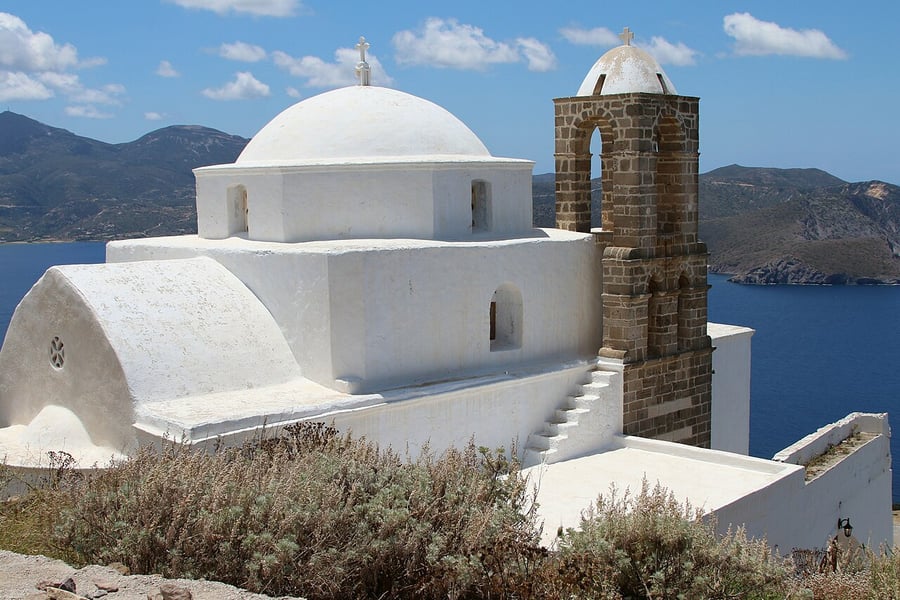
Milos was built by volcanoes, and volcanic rock still covers the larger part of the island. The last eruptions took place about 90,000 years ago. Heat remains below ground, and hot springs on the island reach temperatures of up to 55 °C.
Sarakiniko, on the north coast, shows the white face of the island. Layer after layer of volcanic material formed this pale stone, and fossils lie trapped within it. Other shores show carved rock in a range of colours, so no two beaches look the same.
More than 75 beaches, large and small, line the coast. Plenty can be reached over land, but others open only from the sea. A Milos honeymoon can pair a beach reached by car with a cove reached only by boat.
Eight villages are spread over Milos. Plaka, the capital, shares high ground above the port with Triovasalos, Pera Triovasalos and Tripiti. By the water, the hamlets of Klima, Mandrakia and Firopotamos keep boat houses cut into rock.
- Highest point: Profitis Ilias rises to 751 metres in the west.
- Wild west: Almost all of the western half is protected Natura 2000 land.
- Sea vents: Seabed vents release gas that rises in bubbles.
- Chapels: More than 160 churches and chapels dot the island.
- Crowds: Fewer visitors arrive here than on Santorini or Mykonos.
In short, a Milos honeymoon pairs volcanic scenery with fewer crowds than the busiest Cycladic islands. Daylight hours suit Sarakiniko, the colourful cliffs and boat trips to remote coves. Evenings suit the hill villages, where the capital looks down over the bay.

When is the best time for a Milos honeymoon?
A Milos honeymoon fits late spring or early autumn best. Both seasons bring warm, nearly rain-free days, while the strong summer wind is either light or fading. July and August are the hottest months and the core of the busy tourist season.
The island has a Mediterranean climate: wet, mild winters and dry summers that turn hot. For a Milos honeymoon, four things count: afternoon heat, warmth after dark, rain and wind. The weeks just before and after high summer balance all four.
In late spring, afternoons average close to 23 °C, and nights drop to about 16 °C. Rain is rare then, with only 1.4 wet days in the month on average. The north wind comes only as light breezes, softer than the midsummer gusts.
Heat peaks in July, when afternoons average just over 28 °C and nights stay near 22 °C. Summer is also the season when Milos draws its tourists. The meltemi, a dry north wind of the Aegean, blows hardest in the afternoon.
At its peak the wind hits 7 to 8 on the Beaufort wind scale, enough to stop ferries. By early October the wind season is over, and September highs still sit near 25 °C. A Milos honeymoon in early autumn gets warm evenings and a wind that has eased.
- Late spring: Only 13.1 mm of rain falls in the last spring month.
- June: Highs pass 27 °C, and humidity falls to its yearly low.
- July and August: The hottest pair of months, with the meltemi in full force.
- September: Nights stay near 20 °C, with under one wet day.
- October: Highs ease to about 21 °C, and rain returns.
Couples who like long walks and cool evenings lean towards late spring. A Milos honeymoon built around swimming and warm nights fits early autumn better. Month-by-month figures for rain, heat and wind appear in the overview of the best time to visit Milos.
Where can a couple stay on a Milos honeymoon?
A Milos honeymoon has three kinds of base. Plaka is the car-free hill capital, and Pollonia is a small harbour at the north-eastern tip. The third is a syrma, a painted boathouse at the water in a fishing hamlet.
Plaka stands 220 metres up, on a hill over the bay of Milos. A Milos honeymoon based here starts each evening on foot, because cars cannot enter. Shops, cafés and places to eat line its narrow stone lanes.
Pollonia wraps around a little creek on the north-eastern point of Milos. Fishing boats tie up at its pier each morning with fish, octopus and lobster. A Milos honeymoon in Pollonia has sand on its main beach, plus two other beaches nearby.
Klima has a row of two-storey syrmata dug into the soft rock beside the sea. The lower room was built to keep a fishing boat safe through winter storms. Today the majority are rented, so a couple can stay where fishing families once lived.
Mandrakia, Firopotamos and tiny Fourkovouni keep the same painted boathouses around their coves. Mandrakia offers rooms to rent beside a quiet beach lined with tamarisks. At Firopotamos, owners turn their boathouses into homes for the summer months.
- Pelekouda: Lore says a couple on its rock seat stays together.
- Status: Plaka and Klima became traditional settlements in 1978.
- Census: Pollonia counted 268 residents in 2021.
- Cave church: Agia Paraskevi in Klima has the form of a cave.
- Mandrakia: Its pebble beach runs for nearly 150 metres.
A Milos honeymoon in Plaka gives a car-free hill, cafés and a castle overhead. Pollonia gives a working fishing harbour with its own sandy beach. A boathouse rented in one of the hamlets puts the sea right at the front door.
Which sunset spots suit two people on a Milos honeymoon?
A Milos honeymoon has three main sunset spots. The castle hill above Plaka looks over the bay and nearby Cycladic islands. Klima watches the light fade at sea level, and the empty west coast looks out over open water.
The climb to the castle starts in the lanes of Plaka and ends on the summit. The fort dates from Venetian rule in the 13th century and sits on volcanic rock. At the very top stands Mesa Panagia, a small church with an arched roof, rebuilt after 1944.
A second high seat lies at the western end of Plaka, by the church of Panagia Korfiatissa. It stands on steep rocks above the sea, at a spot called Halara. On a Milos honeymoon, its yard, paved with marble gravestones from the old town, faces the sea.
Klima gives a Milos honeymoon the sunset at the level of the water. The village lines the eastern shore near the mouth of the bay, which opens to the north-west. Its painted boathouses therefore look across the water toward the evening sun.
Nobody lives on the western side of Milos, where Mount Profitis Elias rises to 748 metres. Almost all of this land is a protected Natura 2000 site with over 800 kinds of plants. Beaches on this shore, such as Triades and Kalogries, face west over open sea.
- Monument: Plaka’s castle is a listed ancient monument.
- Skiniotissa: Local talk links this church name to an icon found on a hide.
- Islands: The castle view reaches neighbouring Cycladic islands.
- Marbles: This is the local name for Korfiatissa’s paved yard.
- Endemic: 35 western plant types grow wild only in Greece.
On a Milos honeymoon, the castle gives height, Klima gives the water and the west gives empty land. Both high spots lie within Plaka, a walk apart. More viewpoints, with notes on the seasons, appear on the page about the best sunset in Milos.
What does a private boat day add to a Milos honeymoon?
A Milos honeymoon by private boat reaches coast that no road touches. Kleftiko, on the south-west coast, has white cliffs, rock islets and caves carved by the sea. Other stops include small beaches and caves that open only to boats.
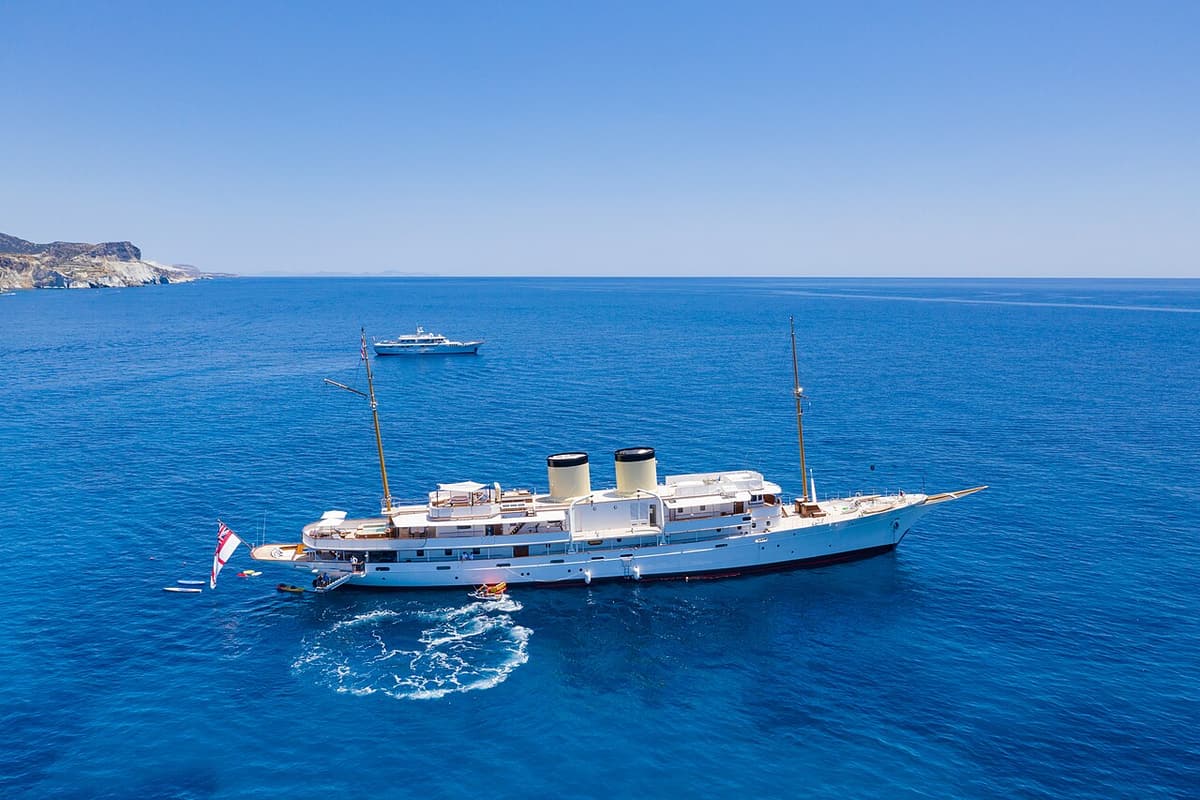
On a Milos honeymoon, a boat day mixes swims, caves and views of the cliffs. Motorboats, sailing boats and caiques, the old wooden boats of the Aegean, all run sea trips. The majority set out from the harbours of Adamas and Pollonia.
With a Milos private boat tour, only the couple and the crew are on board. The two of them choose the order of the stops. A calm cove can keep the boat for a while, and a crowded one can be passed by.
At Kleftiko, white cliffs and rock islets run across three small coves in a row. Sea and wind wore the volcanic rock into hollows and caves. The pale rock formed from pumice, a light volcanic stone, about 3.1 million years ago.
Pirates once used these coves as a base, and the name recalls that era. The caves also served as shelter in bad weather. Fishermen say Mediterranean seals once raised their young here, so a quiet approach suits the place.
- Agios Dimitrios: A chapel stands on this boat-only beach.
- Sykia: Sunlight drops through its open top onto green water.
- Protected: Kleftiko lies in a Natura 2000 area.
- Footpath: A path reaches Kleftiko, but the boat shows it best.
- Minerals: Sea trips show off the island’s mineral wealth.
A Milos honeymoon day at sea strings together Kleftiko, its caves and coves without roads. The couple chooses each stop, while the crew sails and drops anchor. Sykia and Agios Dimitrios add two more places that only a boat can reach.
Which quiet beaches suit a Milos honeymoon?
A Milos honeymoon can include small coves that take real effort to reach. Tsigrado, Papafragas and Gerontas sit at the foot of steep rock or at the end of dirt tracks. On the west side, Kalogries, Triades and Agkathia lie far from any village.
On the south coast, Tsigrado beach has white sand and emerald water. A fairly easy dirt road leads close, then a steep path of loose sand drops down the hill. A Milos honeymoon stop here means a swim inside a ring of rock.
Papafragas sits on the north coast, beside the ruins of ancient Fylakopi. A steep cut in the cliff drops to a tiny beach and a channel of turquoise water. On a Milos honeymoon, one stop here joins a swim with a walk past an ancient site.
Gerontas is the southernmost beach open to cars, and a walk on foot follows the dirt road. A rock arch at the cove joins land and sea like a bridge. The water here is clear, and caves open in the white rock around the cove.
In the north-west, Kalogries is a secluded bay where calm water forms a natural pool. Triades is a row of three coves with shallow, deep-blue water and pale sand. Both lie on the west side, where the beaches are isolated and the roads are rough.
- Agkathia: A long sandy beach fills a sheltered bay past Agia Marina.
- Ammoudaraki: Golden sand lies right beside Triades, down a dirt road.
- Gerontas: Dark sand meets turquoise water below white rock.
- Papafragas: Pirates used this inlet as a base in Byzantine times.
- Supplies: Tsigrado has no facilities; Firiplaka nearby has the basics.
A Milos honeymoon that takes in these quiet coves needs a little planning ahead. Steep paths and rough tracks lead down, so sturdy shoes, hats and water make sense. Other coves on the west side are reachable only from the sea, by boat.
What is a sunset cruise like on a Milos honeymoon?
A Milos honeymoon evening at sea runs along the wild west coast as the sun goes down. Sea trips use motor boats, sailing boats and caiques, meaning traditional wooden fishing boats. The shore holds rock walls, sea caves and quiet coves that no road reaches.
The western half of Milos is its wildest land, and no villages stand there. Almost all of that land falls under the Natura 2000 scheme for protected nature. From the deck, the shore looks bare, with old mines and only a handful of tiny settlements.
On a Milos honeymoon cruise, the boat passes beaches and caves cut off from any road. On the island’s west coast, the sea cave of Sykia has no roof at all. Sunlight falls through the gap onto emerald water, and only a boat can get in.
Mediterranean monk seals use the south-western shore of Milos as a habitat, meaning a natural home. This seal counts as the rarest of all seal species on the planet. Protected birds also live on the western side, among them a rare falcon that migrates.
After the sun slips under the horizon, the sky does not turn dark at once. This stage is called twilight, and it ends at dusk, the darkest moment before night. A Milos honeymoon cruise turns back for the harbour as that last light fades.
- Ports: Sea trips set out from Adamas and from Pollonia.
- Direction: From spring through summer, the sun goes down in the north-west.
- Kleftiko: Wind and sea carved caves into its grey and white rocks.
- Mountain: Profitis Elias, the top summit of Milos, stands in the west.
- Rock: The island is volcanic, with mineral wealth along its shore.
For a Milos honeymoon, an evening trip shows the side of the island that roads miss. Boat types and routes for a Milos sunset cruise are covered on a separate page. A warm layer helps on the ride back at dusk, once the sun has gone.

Which local dishes and wines belong on a Milos honeymoon?
A Milos honeymoon table rests on island cheeses, tomato dishes, small fried pies and almond sweets. Goat cooked with lemon and pasta with myzithra appear at village feasts. Local wine has also come back, with island makers producing bottles shaped by volcanic soil.
On a Milos honeymoon, cheese makes an easy plate to share. Manoura comes from goat’s milk and has a taste of its own. Touloumotyri ages inside an animal skin. Xinomyzithra is creamy and tangy. Arseniko turns spicy in stone storerooms.
Tomatoes run through island cooking. A local variety called bournela becomes beltes, the tomato paste of Milos. Cooks fry tomato fritters and courgette fritters lightly in olive oil. Fouskoma, a sourdough loaf, bakes in a wood-fired oven.
Village feasts, called panigyria, have their own dishes. Skoufomakarono is pasta with myzithra cheese and browned butter. Goat comes lemonato, meaning cooked with lemon. Wine also goes into the pot, with octopus and rooster both cooked in it.
Wine making on the island has had a revival in recent years. Local makers now bottle wines marked by the island’s volcanic soil. Grapes rank among the main crops, next to barley and cotton. A Milos wine tasting brings those bottles into one sitting.
- Pitarakia: Small fried pies come hot with honey.
- Karpouzopita: This sweet pie is made with watermelon.
- Pasteli: These bars mix sesame and honey.
- Kourtalides: Fried dough balls with honey go by this name.
- Thyme honey: Small island producers make it.
One sweet carries a wedding meaning for a Milos honeymoon. Coufeto mixes sweet pumpkin with honey and almonds. At weddings and engagements, the mother of the bride serves it. Its honey points to a sweet life ahead for the couple. Its almonds point to fertility.
How do the villages feel at night on a Milos honeymoon?
A Milos honeymoon evening has three village choices. Plaka sits high on a rock, with car-free lanes and wide views. Pollonia wraps around a small fishing bay. Adamas, the island’s harbour town, pairs quiet streets with nightlife and entertainment.
Plaka, the main town, stands 220 metres above the sea. No cars get in, since walls and houses stand too close together. Its cobbled alleys were first built to protect people from pirates. Small traditional shops, cafes and restaurants line them.
On a Milos honeymoon, an evening in Plaka slowly climbs uphill. Views open over the wide bay of Milos below. At the top stands a Venetian castle from the 13th century. From there, the eye takes in the bay and the neighbouring Cycladic islands.
Pollonia curves around a small bay on the north-east corner of the island. The village has a sandy beach. Taverns and restaurants stretch along the water to the church of Agia Paraskevi. At the pier facing the church, the local catch comes ashore: fish, octopus and lobster.
Left of the village lies Pelekouda, a peninsula. The church of Agios Nikolas sits on the same side. A rock nearby has the shape of a chair. Local tradition holds that two people who sit there side by side stay a couple for life. It is an easy evening stop on a Milos honeymoon.
- Plaka: Only motorbikes and mopeds fit its lanes.
- Pollonia: Its name recalls an old temple of Apollo.
- Distance: Pollonia is 14 km from Plaka.
- Adamas: White houses there have small flowered yards.
- Diamond: Adamas is the Greek word for diamond.
Adamas suits a later night out, with nightlife and entertainment. Refugees from Sfakia in Crete built the town on the north side of the gulf. Its natural bay is among the Mediterranean’s largest and safest. A Milos honeymoon evening there ends by the water.
Is Kimolos or Polyaigos the better day trip on a Milos honeymoon?
A Milos honeymoon day trip can go two ways. Kimolos is a small, lived-in island with a village on a hill and a whitewashed port. Polyaigos has no residents at all, only goats, sea caves and beaches on its southern side.
Kimolos sits across a narrow strait, only about one kilometre wide. A small ferry from Pollonia makes the crossing simple on a Milos honeymoon. The 2021 census counted 810 people there. Chalk takes its Greek name, kimolia, from the island.
The main village is simply called Chorio. Its inner part, Mesa Kastro, grew around a medieval castle, with domes and arches. The outer part, Exo Kastro, has square, plain buildings. On summer evenings, part of Chorio closes to cars.
Polyaigos is a different sort of day. No one lives there now, and its name points to plenty of goats. It is the largest island in the Aegean without people. Visits leave from nearby Kimolos on private boats, both conventional boats and speedboats.
The islet sits inside Natura 2000, the European Union’s network of protected sites. Mediterranean monk seals shelter in its sea caves and have their pups on the island. Eleonora’s falcon, a bird of prey, is protected there under a special zone. On a Milos honeymoon, this is the wild side of the trip.
- Beaches: Polyaigos has Panagia, Mersini and Ammoura beaches.
- Lighthouse: A stone lighthouse has stood on Cape Maskoula since 1898.
- Monastery: Ruins of a monastery founded in 1622 stand there.
- Old dispute: Judges from Argos once gave the islet to Kimolos.
- Museums: Chorio has an archaeological and a folklore museum.
A Milos honeymoon can give each island its own day. Kimolos suits a walk on its trails and a swim in crystal-clear water. Polyaigos suits swims from the boat. Details on boats and routes sit on the page about a Polyaigos boat trip.
What history suits a Milos honeymoon for two?
A Milos honeymoon can cover three ancient places on one hillside near Trypiti. Early Christian catacombs lie there, near a Roman theatre above the bay. The Venus de Milo was dug out of a farm field on the same slope.
The catacombs are an underground Christian cemetery dug into soft volcanic rock. The site stayed in use from the 1st to the 7th century AD. Digs found pottery from Asia Minor, Cyprus and North Africa.
On a Milos honeymoon, the details inside reward a slow look. A green fish was painted above the head of one burial. One inscription opens with ΕΝ ΚΩ, meaning “in the Lord”, and lists rare Christian names.
The Roman theatre stands above the seaside hamlet of Klima. Its orchestra, the flat floor before the seats, sits 1.60 metres below the front row. That drop let it serve as an arena for duels and animal fights.
The ancient town once covered this slope between Trypiti and Klima. A farmer found the statue there on 8 April 1820, in a four-sided niche. Its road to Paris is traced on the page about the Venus de Milo.
- Name: Trypiti means “made with holes”, after its rock-cut caves.
- Seats: The dug-out lower tiers hold about 800 people.
- Gift: A Bavarian king handed the theatre to his son Otto, king of Greece.
- Apple: The same dig yielded a marble hand gripping an apple.
- Copy: A faithful copy of the statue stands in the Plaka museum.
Only 200 metres separate the catacombs from the theatre. A couple can pair both sites in one outing. The original has been in Paris, at the Louvre, since 1821. The copy in Plaka is the version kept on the island itself.

How do couples move around on a Milos honeymoon?
A Milos honeymoon runs smoothly with a car or a scooter for the western dirt roads. Summer buses serve part of the island. Boats from Adamas and Pollonia reach coves that no road touches. Taxis cover the gaps.
No island in the Cyclades has a larger web of dirt tracks than Milos. The west, the wildest half, has no villages, only a scatter of small settlements. Tracks there end at coves, chapels and old mines.
On a Milos honeymoon, a car handles the roughest stretches best. Parts of these routes are very hard going. A scooter suits the paved roads and the gentler tracks. Off-road motorbike rides are a pastime in their own right.
Public buses cover parts of the island, and summer brings frequent runs. Tickets are bought on board. No bus serves the airport, about 4 km from Adamas. A cab or a car covers that ride.
Boats open the third route, along the coast. They leave Adamas and Pollonia for beaches beyond the reach of any road, and for sea caves. Couples on their own yacht can moor at Adamas or Pollonia.
- Cape Vani: A track runs there from Empourios and on to old mines.
- Trachilas: Just before Firopotamos, a track climbs left to this lonely beach.
- Profitis Elias: The road to the 748-metre top looks toward Kleftiko.
- Taxis: Fifteen cabs work from the port and the airport.
- Mooring: Wind direction decides which coves suit a boat that day.
A Milos honeymoon can mix all three ways of moving. A car day in the west, a bus ride and a boat to the coves fit together well. Sea trips and land outings share the list of activities in Milos.
What do couples ask before a Milos honeymoon?
A Milos honeymoon raises practical questions about time, season and transport. Couples ask how long to stay, what a short trip covers and whether a second island fits. Others ask about winter, boats, quiet bases, photos and crowds.
What length of stay suits a Milos honeymoon?
The island splits into clear zones, and each one fills a day. The hill villages and old sites above Adamas make one. The empty west by car makes a second, and a coast trip by boat a third. A spare day helps, since wind decides which coves boats can use.
What fits into a short Milos honeymoon?
A short stay works best on the high ground above Adamas. Plaka, Trypiti and Triovasalos sit close together there. The catacombs, the theatre and the Plaka museum lie within easy reach. Kastro rises on the hill above Plaka. One boat trip from Adamas adds the coast, while the west waits.
Can a Milos honeymoon include a second island?
Kimolos lies about 1.6 km off the north-east coast. Pollonia is the smaller port that serves that crossing. In the summer months, ferries also link Milos with Syros, Paros, Naxos, Folegandros and Santorini. Crete and Rhodes join the summer list. A couple can end the trip on another island.
Does a Milos honeymoon work in winter or spring?
Rain falls in the mild Milos winter, and the summers stay dry and hot. Out of summer, the trip leans on walks, villages and history over beaches. The protected west holds over 800 plant kinds, 35 found only in Greece. The Venus itself came out of the ground in April.
Which boat trip suits a Milos honeymoon best?
A trip around the coast earns its place. It reaches beaches with no way in from land. Sailboats and other craft set out from Adamas and Pollonia. On the way, the route passes sea caves and cliffs rich in minerals. Boats can anchor at Kleftiko when the wind direction allows.
Where is a quiet base for a Milos honeymoon?
Quiet comes from distance to the ports. Adamas is the main harbour, and Pollonia is the smaller one, linked to nearby Kimolos. Up on the plateau, Trypiti and Triovasalos sit above the bay, away from the ferry quay. The small seaside settlements of Klima and Mandrakia offer one more choice.
Where are the best photos on a Milos honeymoon?
The marble seats of the theatre look down over the bay. At Sarakiniko, white volcanic rock lies in layers, with fossils found inside. From the summit road of Profitis Elias, the sea spreads out below. Inside the protected zone, Achivadolimni, the largest natural wetland in the Cyclades, draws migrating birds.
Which weeks are busiest for a Milos honeymoon?
The summer months bring the crowds, since Milos is a popular summer destination. Ferry links to other Cycladic islands and bus runs are frequent then. Even so, Santorini and Mykonos still draw more visitors than Milos. Couples who want quiet roads can head west, where no villages stand at all.