
A Milos taxi is the simplest way to cross the island of Milos without driving. This volcanic Greek island lies in the Aegean, at the southwest edge of the Cyclades. In summer, crowds of visitors land by ferry and plane, and each group needs a ride.
Taxis on the island meet ferries at Adamas, wait at the small airport and climb to Plaka. This page explains, step by step, how a Milos taxi works at each stop. Later parts cover beaches, buses, rental cars, island tours with a driver and the size of Milos.
How does a Milos taxi work for first-time visitors?
A Milos taxi takes one group of passengers straight from one point to another. Nobody else joins the ride on the way. Travellers can wait at the taxi rank, phone for a car, or book one well ahead of time.
A taxi is a vehicle for hire with a driver at the wheel. The passenger picks both the start point and the end point of the trip. A bus differs, because the operator sets every stop on its route.
A taxi rank, also called a taxi stand, is a spot where empty cars wait in a line. The car at the front of the line takes the next passenger. On Milos, taxis wait for customers at both the port and the airport.
Calling by phone is the second way to get a Milos taxi. Taxi services commonly run a central office that takes these calls. The office then sends a free car, such as the one closest to the pick-up address.
Booking a Milos taxi ahead means agreeing on a place and a moment for the pick-up. This step matters in high summer, when the island fills with visitors. A booked car waits for its passenger, so nobody has to compete for a ride.
The whole island runs on just 15 taxis, a small fleet for a busy summer. The cars are fairly modern models, roomy inside and fitted with air-conditioning. That small number is the main reason to book ahead in the busy months.
- Drivers: Taxi drivers on Milos have a name for being careful, clean, helpful and reliable professionals.
- Car makes: The fleet mixes car models from European, American and Japanese makers.
- Wireless internet: A share of the cars offer wireless internet to passengers on board.
- Hailing: A taxi can also be stopped with a raised hand at the roadside, a habit called hailing.
- Not a rental: Unlike a rental car, a taxi never asks the passenger to drive or park.
A Milos taxi works much like a taxi anywhere else, only on a smaller scale. The fleet is tiny, while summer brings a steady flood of visitors. Travellers who book early and know where each rank sits start their island stay with ease.
How does a Milos taxi from Adamas port work?
A Milos taxi from Adamas port starts at the taxi rank in the port. When a ship docks, a large crowd steps off at the same moment. The small fleet fills fast, so travellers who book a car ahead skip the queue.
The harbour town of Adamas serves as the chief port of the island. Its white houses are the first sight from the deck of an arriving ship. The town sits on the north side of a wide, sheltered bay.
A ferry lets its whole crowd off in one wave. Families, hikers and couples all head for the same Milos taxi rank. With such a small fleet, the line forms fast and moves in turns.
At the rank, each Milos taxi takes the next group in line. A car returns only after dropping its last passengers somewhere on the island. That round trip leaves gaps, and the queue grows while the cars are away.
Booking a Milos taxi before the ferry lands removes that wait. The driver knows the ship, the arrival point and the size of the group. Travellers with heavy bags or small children gain a great deal from this step.
Ferries from Piraeus, the port of Athens, are the cheapest of the ways to reach Milos. Direct ships sail straight in, while others first call at Kythnos, Serifos and Sifnos. In summer, links also run to Paros, Naxos, Santorini, Crete and Rhodes.
- Name: The name Adamas comes from the Greek word for “diamond”.
- Old name: In earlier times, the town went by the name Alamanto.
- Founders: Refugees from Crete built the first homes of the town.
- The bay: The harbour lies inside the sunken centre of the chief volcanic crater on Milos.
- Sights in town: Visitors find a mining museum, a maritime museum and a French graveyard from Crimean War days.
A Milos taxi from the port is easy to find but hard to catch in peak season. Adamas is the cultural and business heart of the island, and also its largest tourist centre. A short wait at the rank is normal when a big ship has just arrived.

Why is a Milos taxi the main link from the airport?
A Milos taxi is the main ground link between the small island airport and the rest of Milos. The airport lies southeast of the harbour at Adamas. Taxis are on hand at the airport, and private cars make up the other link.
The airport is close to the harbour town, so the trip to Adamas is a short one. Its IATA code, the three-letter tag on bags and tickets, is MLO. The airport first opened to flights on 17 January 1973.
The runway is short, so only small passenger planes can land here. The apron, the paved area where planes park, covers just 7,800 square metres. It fits one plane of the largest allowed type, or two light aircraft, at once.
Direct flights link Milos with the main airport of Athens on the mainland. The plane on this route tends to have 50 seats. A full flight brings a modest group, not a crowd the size of a ferry load.
Booking a Milos taxi before the flight is a sound plan. Because the fleet is small, a free car is not always waiting at the terminal. A booked driver meets the group at the exit, so nobody stands around in the heat.
- Terminal: A new terminal building opened to passengers in October 1995.
- Runway plans: A new runway, 2,000 by 45 metres, was planned but shelved for lack of money.
- Apron plans: The same plan aimed to grow the apron to 26,000 square metres.
- Airport rank: Taxis serve the airport as well as the port, so both arrival points have cars.
- Official name: The site carries the name Milos Island National Airport.
A Milos taxi from the airport is a short, simple ride to the port or the hills. Planes are small, so crowds at the terminal stay modest. Still, the fleet is tiny, and a booking made before take-off brings real peace of mind.
How does a Milos taxi reach Plaka and the hill villages?
A Milos taxi climbs from Adamas to the plateau above the harbour, home to Plaka. Cars cannot enter the lanes of Plaka itself. The driver stops at the edge of the village, and passengers walk the last stretch on foot.
Above the port lies a plateau, a flat stretch of high ground. Plaka, the chief town, sits up there with the Kastro hill above it. Triovasalos is the first village on the way up from the harbour.
A big rock lifts the village of Plaka 220 metres above sea level. Its official name is simply Milos, the same as the island. The view from its edge looks out over the Gulf of Milos.
In Plaka, walls and houses crowd so tightly that a car cannot pass between them. Only motorbikes, mopeds and people on foot squeeze through its paved lanes. A Milos taxi therefore drops its passengers at the edge of the village.
From the Milos taxi drop-off point, the rest of the trip is on foot. Light bags help, since every bag must travel by hand beyond the car stop. Travellers staying inside Plaka can ask the driver for the nearest point to their room.
- Name: The first settlers built on level ground, and that flat site gave Plaka its name.
- Castle: The hilltop over Plaka holds a castle built by the Venetians in the 13th century.
- Population: The 2021 census counted 902 people living in Plaka.
- Triovasalos: The Karodromos there is a central spot for the whole island, with banks, public offices, cafés and shops.
- Trypiti sights: From Trypiti, a walk on foot reaches both the catacombs and the ancient theatre.
A Milos taxi to Plaka ends at the village edge, not at a front door. Trypiti almost touches Plaka, and Triovasalos sits on the road up from the port. For the return trip, naming a clear meeting point on the road saves time.

How does a Milos taxi reach the beaches of the island?
A Milos taxi reaches Provatas on the south coast along a paved road. Other beaches lie past rough dirt tracks or down steep paths. A third group, like Kleftiko and the Sykia sea cave, is reached only from the sea.
Provatas lies 7 km from Adamas, and the paved road there has clear signs. Its golden-red sand and very shallow water suit families with young children. That easy road turns the beach into a simple Milos taxi trip.
Tsigrado, close to Fyriplaka, shows how fast the ground changes. A fairly easy dirt track leads to the high ground above the beach. From there, swimmers climb down a steep, sandy trail to white sand and emerald water.
Gerontas is the farthest south-coast beach that a car can reach. Getting there means a rough dirt road and then a walk on foot to the cove. Before a Milos taxi takes such a track, riders can check it with the driver.
Kleftiko, a cluster of grey-white rocks and caves, is reached only by small boat or sailboat. Boats for it leave from the little harbour at Kipos. So a Milos taxi to Kipos covers the land part of that day.
Wind shapes the choice of beach as much as the road does. On meltemi days, when north winds blow, the gulf and the south coast are the better choice. With south winds, the north coast wins, and a Milos taxi makes a late switch easy.
- Paliochori: This beach of almost 2 km has hot water rising among red, pink and yellow rocks.
- Fyriplaka: Past the organised first beach, two quieter coves wait for those who walk along the shore.
- Sykia: This sea cave has no roof, so sunlight falls straight onto its green water.
- Agios Dimitrios: At the western tip of the gulf, this small sandy cove takes boats only.
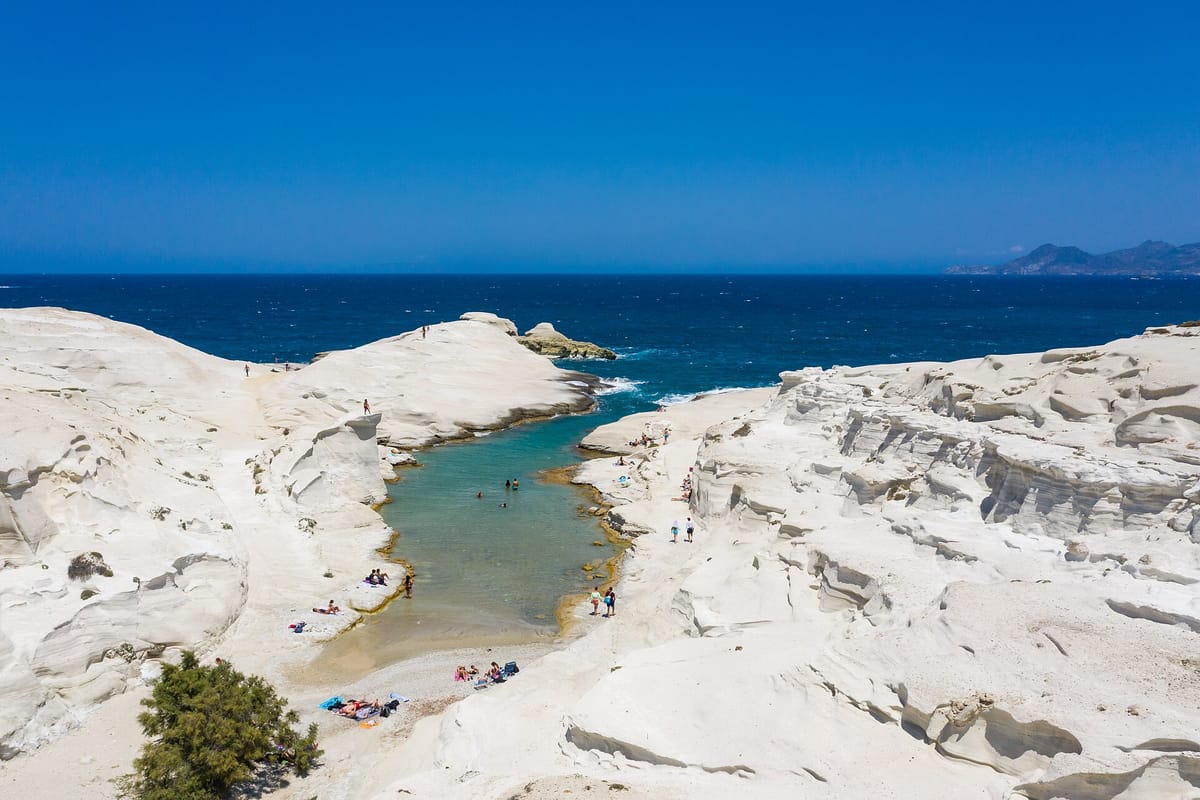
- Sarakiniko: The white volcanic rock of Sarakiniko beach lines the north shore around a small natural harbour.
Further coves appear in the full list of beaches of Milos, one by one. Before booking a Milos taxi, it helps to name the exact cove. Alogomantra shows why: its strip of sand hides behind tall rocks, out of sight of the road.
Milos taxi, bus, rental car or scooter: which one fits?
A Milos taxi suits arrivals with luggage, short hops and late nights out. The public bus fits trips to the beaches and villages on its routes. A rental car or a scooter suits those who want to roam remote coves at their own pace.
A taxi is a vehicle for hire, taken point to point, with someone else at the wheel. Arrivals find cabs waiting at the harbour and at the airfield alike. That makes a Milos taxi the simplest first ride on the island.
The public buses serve certain parts of Milos, not every corner. In the summer months, buses run at short gaps, and tickets are bought on board. Provatas beach has a frequent bus link, while spots off the routes call for a Milos taxi.
With car rental, visitors do the driving themselves and stop wherever they like. That freedom pays off at Patrikia, a set of three secluded coves inside the gulf. Reaching them takes a dirt road by car and then a stretch on foot.
A scooter, or moped, is a light motorbike with a small engine. Plaka’s narrow lanes admit two-wheelers like these, yet no cars. Summers here are hot and dry, so long rides on two wheels are tiring under the sun.
Short trips from the port need little planning. Papikinou, a long beach, lies only 1 km east of Adamas, and its water deepens slowly. A Milos taxi covers such a hop with ease, and so does a scooter.
- Kapros: Cars and buses reach this small sandy cove with ease, within sight of the Pollonia road.
- Lagkada: The beach nearest to Adamas port is organised, with tamarisks for natural shade.
- Kastanas: Just south of Pollonia, this wild east-coast beach has pebbles instead of sand.
- Voudia: This large pebble beach stays off-limits because of the mining works around it.
- Kolympisionas: This small beach has deep blue water and colourful pebbles.
Mixing the options works well, and the bus covers the beaches on its routes. A Milos taxi handles the port, the airport and late nights. A rental car or scooter then opens up the far coves for a day of slow exploring.

When does a private transfer or a Milos taxi with a driver fit?
A Milos taxi booked as a private transfer fits arrival and departure days, with one fixed pickup. A car with a driver for the whole day fits an island tour. It lets a group see far corners without renting a car or reading a map.
A pre-booked transfer is a ride arranged before the trip, not found at a taxi stand. The idea comes from private hire cars, which are licensed for pre-booking only. The driver knows the pickup point and the drop-off in advance.
A transfer suits a first night far from Adamas, a family with bags or a late ferry. With a small taxi fleet, an arranged pickup cuts the risk of a wait. A Milos taxi can be booked this way for the return to the port or airport.
An island tour by car with a driver links stops around Milos in a single day. The driver handles the roads, the parking and the route between villages. Riders simply step out at each stop, which suits groups and older visitors.
The choice depends on the plan for the day. A Milos taxi on a transfer covers one trip from point to point and ends there. A driver for the day waits at each stop, so beaches and villages fit into one loop.
An island tour of Milos is a ready-made version of the same day. For dirt tracks, a jeep tour on Milos uses a four-wheel-drive car. Such a car sends power to all four wheels, not just two.
- Phylakopi: The ruins of this Bronze Age town lie on the north-east coast.
- Catacombs: The catacombs of Milos form a maze of passages about 185 m long.
- Sulphur mines: Ruins of old sulphur mines, which worked until 1956, stand by a small east-coast cove.
- Hot springs: Hot sulphur springs rise along the east side of the harbour.
- Papafragkas: Three sea caves sit beside Phylakopi, and a steep path cut in the rock leads down.
Booking a Milos taxi with a driver for a full day works well for groups of friends. Sharing one car keeps the whole party together between stops. For a single ride with heavy bags, a plain transfer remains the simpler pick.
What helps a Milos taxi ride go smoothly in the summer peak?
A Milos taxi is worth booking ahead in summer, since the island’s taxi fleet is small. Big bags, small children and late returns from Plaka all call for a clear plan. Friends heading the same way can share one car and travel together.
Milos is a popular place to visit in summer. In those months, ferries link it with a long list of Cycladic islands and beyond. With demand that high, a Milos taxi booked a day ahead saves a wait at the port.
Taxis on Milos are fairly modern cars, roomy and fitted with air-conditioning. Still, the boot, the storage space at the back, has limits. Groups with large cases or a pushchair can mention the bags when booking.
Parents travelling with babies or toddlers can request a child seat at the time of booking. A child seat is a small safety seat fixed into the car for young passengers. Asking early is the clearest way to know whether one is ready.
Late nights in Plaka end at the edge of the village. Its maze of lanes stays closed to cars, so drivers wait outside. Diners leaving a late meal walk out to the agreed spot and find their Milos taxi there.
A taxi normally works on an exclusive, non-shared basis, with one party per ride. Friends heading to the same beach or village can therefore pile into one car together. Fewer cars on narrow island roads is a welcome bonus for everyone.
- Yacht crews: Sailors on their own boats tie up at the Adamas marina or at Pollonia.
- Wireless internet: Certain taxis on Milos even offer wireless internet on board.
- Summer links: In the warm months, ferries also run between Milos and both Crete and Rhodes.
- Port town: Adamas, the harbour town, serves as the island’s hub for trade and culture.
- Crowds: Milos draws fewer visitors than Santorini or Mykonos, though its popularity has grown in recent decades.
A smooth Milos taxi ride in summer starts with an early booking and a clear pickup point. A word about bags or a child seat helps the driver plan. Late returns from Plaka go best when the ride back is set up early.
How does a Milos taxi reach Pollonia and the Kimolos ferry?
A Milos taxi can drop riders at Pollonia, a fishing village with a small port of its own. The port mainly serves the crossing between Milos and neighbouring Kimolos. Trips out to the Glaronisia also set off from this harbour.
Built around a small cove, Pollonia is a fishing village that also goes by the name Apollonia. It sits at the eastern end of the north coast of Milos. Its beach has plenty of sand and lots of tamarisks, trees that grow well beside salt water.
The port at Pollonia is smaller than the main harbour at Adamas. Kimolos lies to the north-east of Milos, across a narrow stretch of sea. The village itself is easy to reach both by car and by public transport.
A Milos taxi from Adamas or the hill villages drops riders near the boats at Pollonia. Day-trippers heading to Kimolos can ask the driver to come back for the return trip. Agreeing on the pickup spot before stepping out saves confusion later.
Kimolos was famous in ancient times for its figs and for fuller’s earth. Fuller’s earth is a soft clay once used to clean wool and cloth. Visitors keen to see the island from the water can book a Kimolos boat trip instead.
Boat owners can also tie up at Pollonia, as well as at the marina in Adamas. That makes Pollonia a second sea gate for the island. Sailors who land there can call a Milos taxi for the trip inland.
- Food: The village has tavernas, restaurants and island cafés.
- Glaronisia: The island’s list of settlements names the Glaronisia as a place with no residents.
- Big ferries: Ferries from Piraeus sometimes call at Kimolos on the way to Milos.
- Old dispute: Milos and Kimolos once argued over nearby islets, and the people of Argos ruled for Kimolos.
- Ruins: Kimolos once held a large city, and its remains still cover a cliff there.
For a Milos taxi to Pollonia, the key detail is the boat plan. Riders bound for Kimolos can tell the driver they need to catch a crossing. On the way back, a pickup booked ahead avoids a long wait at the quay.

Can a Milos taxi reach Klima, Firopotamos and Mandrakia?
Yes, a Milos taxi can take riders to Klima, Firopotamos and Mandrakia. These are small fishing settlements, each built in a cove along the shore. Each is known for its syrmata, colourful boat houses dug into soft rock by the sea.
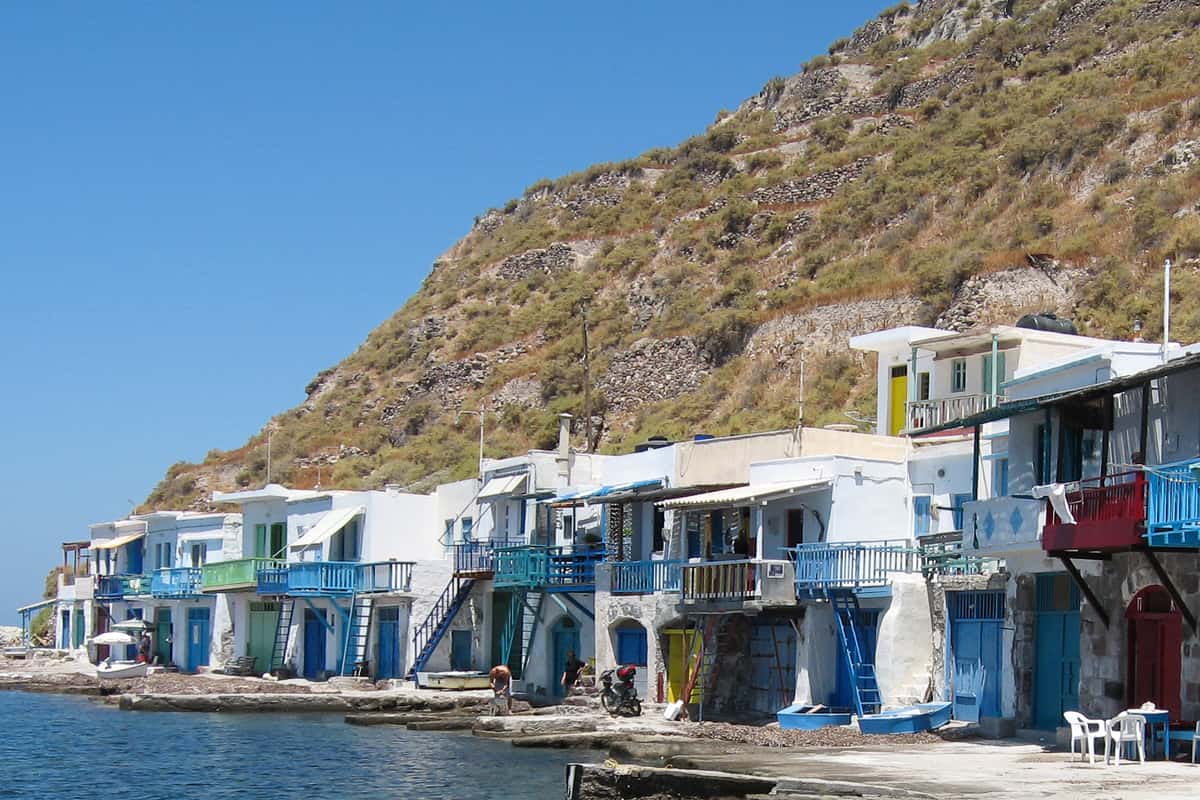
Syrmata are two-storey fishermen’s houses set right at the edge of the sea. The ground floor held the family boat in winter, and the family had its rooms upstairs. Bright paint covers their doors and window frames.
Klima had just 8 residents at the 2021 census. Its colourful houses sit in natural hollows in the rock along a small bay. Today, visitors can rent rooms inside the old boat houses and stay right by the water.
Firopotamos sits by the sea, and its small sandy beach has a beach bar. Its cove is ringed by syrmata, and tamarisks grow by the sand. Past the fishermen’s houses stands an abandoned loading dock, once used to put cargo onto ships.
A Milos taxi can also reach Mandrakia, an old fishing village with colourful syrmata all around it. It has rooms to rent and a place to eat. Tamarisks grow by its quiet beach, which stretches almost 150 metres over fine, dark grey pebbles.
- Ancient town: The slope between Trypiti and Klima once held the ancient city of Milos.
- Famous find: Near Klima lies the spot where the Venus de Milo statue came to light.
- First port: Ruins near Klima include remains of the old town and the island’s first harbour.
- Small church: A small church stands at the far end of the Firopotamos cove.
- More harbours: Areti, Agios Konstantinos, Fourkovouni and Emporios are also small fishing harbours.
Riders can ask a Milos taxi to stop above the water and walk down to the boat houses. A return pickup agreed in advance keeps the trip simple. A wider look at the villages of Milos helps plan the order of stops.
How big is Milos, and what does that mean for a Milos taxi?
A Milos taxi covers an island of about 151 square kilometres. Milos measures about 23 km across one way and 13 km from north to south. Its horseshoe shape wraps around a large bay, so rides between the halves bend around the water.
Shaped like a horseshoe, Milos curls around a deep natural harbour. That harbour fills an old volcanic crater and splits Milos into two near-equal halves. An isthmus, a narrow neck of land no more than 2.2 km wide, joins them.
This bay is one of the biggest natural harbours anywhere in Greece. Its water runs from 130 down to 55 metres deep. The harbour town of Adamas sits on its shore, and ferries dock there.
No villages stand in the western half, the island’s wildest corner. Just a handful of tiny hamlets and old mines dot those hills. Nearly the whole area falls under Natura 2000, which links protected wild places across Europe.
This land holds over 800 taxa, or types of living things, and 35 exist only in Greece. The south-west coast is home to the Mediterranean seal. Beaches out here are remote, so a Milos taxi ride to them is a long one.
- Dirt road: Out west, Agios Ioannis beach sits at the end of roughly 12 km of dirt road.
- Tiring route: The way to the three Triades beaches in the west is a tiring one.
- Wetland: Achivadolimni, inside the Natura zone, is the biggest natural wetland found anywhere in the Cyclades.
- Old forest: The west also holds a rare forest of centuries-old cypress trees with spreading branches.
- Working mine: A pozzolana mine at Xylokeratia, digging volcanic ash for cement, is the only one still running there.
For a Milos taxi, trips in the eastern half link the port, the villages and the airport. Trips into the wild west mean dirt tracks and long distances. Riders can ask the driver in advance whether the track to a chosen beach suits the car.
What do first-time visitors ask about a Milos taxi?
A Milos taxi waits for arrivals at the port and the airport, and drivers take phone bookings too. The island’s own taxi fleet is quite small. That is why planning ahead matters in the busy summer months on Milos.
How can visitors find a Milos taxi?
Taxis wait for arriving passengers at the port in Adamas and at the airport. Away from those two spots, the simplest way is to phone the drivers for a car. The island’s taxi fleet is small, so calling early helps a lot on busy summer days.
Is it smart to book a Milos taxi ahead?
Yes, booking ahead is wise in summer, when Milos is a popular spot for visitors. With such a small fleet on the island, a booked car avoids a long wait on arrival. Sharing the ferry or flight details when booking helps the driver meet the right arrival on time.
Can a Milos taxi meet a ferry at the port?
Yes, taxis wait at the port in Adamas, the harbour town where the main ferries dock. Adamas is also the island’s cultural and commercial centre, with a mining museum and a maritime museum. From the quay, a taxi can climb to the hill villages or cross to Pollonia.
Is there a Milos taxi at the airport?
Yes, taxis wait for arriving flights at the airport, just as they do at the port. Besides private cars, taxis are what connect the airport to other parts of Milos. The airport lies south-east of the harbour, and its short runway takes only small planes.
What is a Milos taxi transfer?
A transfer is a ride booked ahead between two fixed points, such as the port and a hotel. Like any vehicle for hire, the rider picks the start and end points and does not drive. The driver meets the rider on arrival, which helps with late ferries and heavy bags.
Is a Milos taxi better than a rental car?
It depends on the plan, since a Milos taxi spares riders from driving and parking. Cars cannot enter Plaka at all, and only motorbikes and mopeds fit its narrow lanes. A rental car gives more freedom for long beach days on the dirt tracks of the wild west.