- Food in Palaioxori
- Food in Plaka
- Food in Pollonia
- Food in Provatas
- Food in Triovasalos
- Food in Zefiria
Food in Milos is shaped by a dry volcanic island in the Cyclades. The Aegean supplies fish, octopus and lobster, while the dry hills supply capers, tomatoes and herbs. The plates stay plain because the ingredients carry the flavour. This page follows the volcanic island of Milos from the harbour to the hillside, starting with the catch.
Two sections follow. The first covers fish and seafood: what is caught, how it is cooked and which harbours land it. The second covers vegetables, capers and herbs, and the dry ground that grows them. Food in Milos also includes cheese, pies, sweets and wine, and those have their own place in the food and drink section of the site.
What fish and seafood make up food in Milos?
Food in Milos relies on a sea full of fish, with red mullet, sea bream and other species alongside octopus, squid, cuttlefish and lobster. Fishermen work with nets, longlines, trolling lines, vertical lines and rods, and the kitchens grill, fry or cook the catch in wine.
Fishing around Milos is done from a boat, from the shore and underwater with a spear. The tackle includes nets, longlines, trolling lines, vertical lines and rods. The marine life of Milos is extremely rich. The catch carries Greek names such as barbounia (red mullet), lythrinia, tsipoures (sea bream), sargoi, melanouria, skatharia and magiatika. Octopuses, squid, cuttlefish and lobsters come from the same waters. Each haul reaches the table through a harbour, which ties food in Milos closely to the quay.
Octopus follows a set routine on the Greek islands. Spearfishing close to the shore brings it in, and the fisherman pounds the flesh against stone to tenderise it. The octopuses then hang in the sun from a rope like washing on a line. Later they are served grilled, hot or chilled in a salad, with olive oil, garlic, oregano, pepper and lemon juice, or as a meze beside ouzo. Lobster pasta is another named dish of food in Milos, with lobster meat in a tomato-based sauce over pasta.
Harbours decide where food in Milos lands. Adamas is the harbour town, and the natural harbour of Milos is the hollow of the main crater, which cuts in from the north-west and splits the island into two nearly equal halves. Pollonia is the second harbour, almost 10 kilometres from Adamas, and a small boat links it with Kimolos. Mandrakia, 4 kilometres north of Adamas, keeps boats and fishing gear in its syrmata (wires). At Klima the syrmata are two-storey houses, with the family upstairs and the boat below in winter.
- Marides: Small whitebait are dusted lightly with flour and fried.
- Kalamarakia: Fried squid slices are served with a lemon wedge.
- Sardeles psites: Roasted sardines are a named dish of Greek fish cooking.
- Garides saganaki: Shrimps are sautéed in ouzo, then covered in tomato sauce and crumbled feta.
- Kakavia: This fish soup combines fish, onions, potatoes, olive oil and vegetables.
Fish and seafood connect food in Milos to its harbours. Boats work from Pollonia, Mandrakia and Klima, and the kitchen grills the catch, fries it or cooks it in sauce. Octopus dries in the sun, whitebait is fried and lobster goes into pasta. The next section leaves the quay for the hillside, where capers, herbs and vegetables grow on dry volcanic ground.

Which vegetables, capers and herbs grow for food in Milos?
Food in Milos draws on capers, tomatoes, courgettes and the herbs thyme, oregano and sage, all of which suit dry ground. The island is too dry for lush vegetation, so hardy plants on rocky volcanic soil supply the seasoning and the vegetables.
Milos is a volcanic island, and tuff, trachyte and obsidian are among its ordinary rocks. The ground is too dry for lush growth, and summers are warm to hot and dry. Orange, olive, cypress, tamarisk, juniper and arbutus trees grow across the island, and the hill slopes carry low vegetation made of species that resist grazing. These conditions limit what food in Milos can take from the field, and they explain why the plants that do grow are hardy ones.
The caper bush suits this ground. It is a small shrub with stems that lie along the soil, broad leaves and white flowers, and it tolerates drought and heat and prefers to flower in summer. The part used in the kitchen is the bud, picked before it opens and then pickled in salt or in salt and vinegar. Its flavour is sometimes compared to black pepper or mustard. Capers on Milos grow in abundance on rocky soil, which makes them a natural part of food in Milos.
Herbs grow on the same dry slopes. Thyme heads the list of well-known Greek low shrubs, and sage grows beside it, with downy grey-green leaves and pale violet flowers at the end of spring. Oregano is said to take its name from Greek words for mountain and joy, and Greek cooking uses it more than other Mediterranean kitchens do. The low scrub of Greek hills swaps large winter leaves for small downy summer leaves to save water, and the herbs of that scrub season food in Milos.
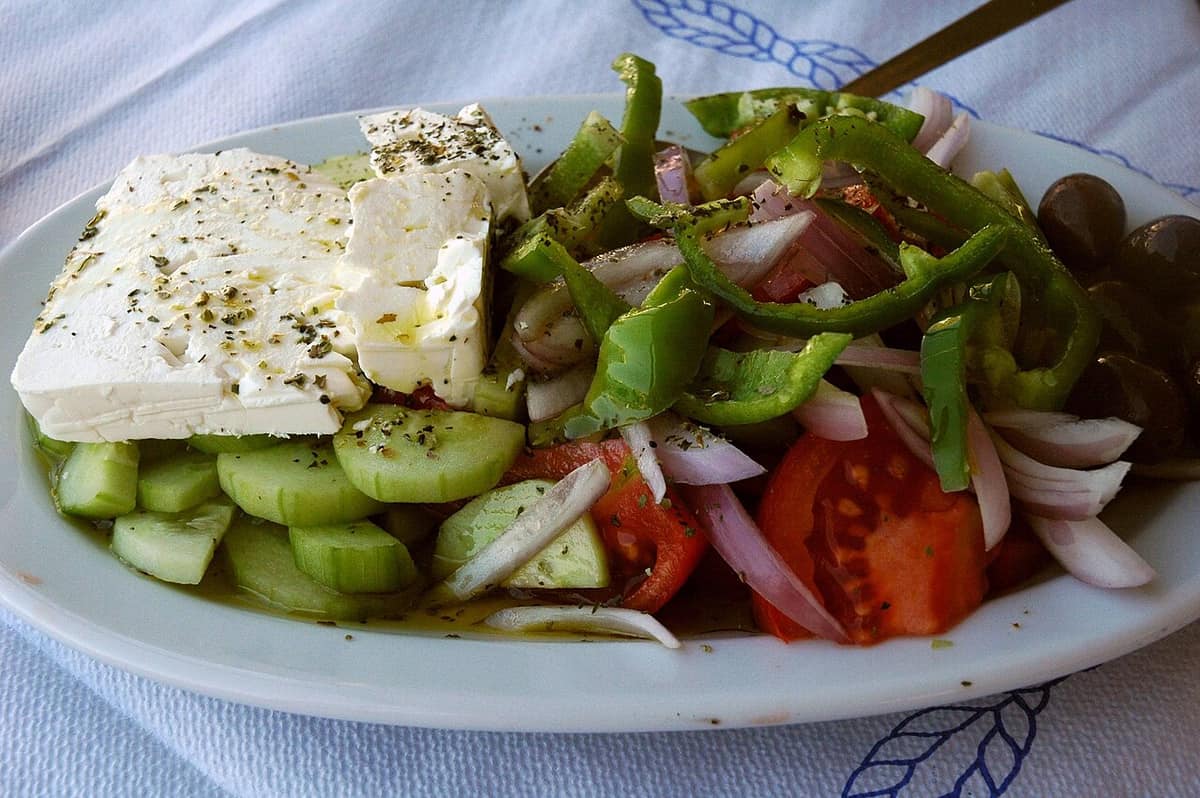
Vegetables fill the gaps between herbs and capers. Greek cooking counts tomatoes, aubergines, potatoes, green beans, okra, peppers and onions among its important vegetables, and Milos adds the bournela tomato and the courgette to that list. Peas, cauliflower, spinach and leeks join the stewed dishes. Ladera, a Greek word meaning oily, names the vegetable dishes cooked in olive oil, and olive trees grow across the island. Vegetables, capers and herbs together make up the plant side of food in Milos.
- Briam: Aubergines, courgettes, onions, potatoes, tomatoes, garlic and parsley are cooked together in olive oil.
- Gemista: Tomatoes and peppers are baked with rice, onions, mint, parsley and olive oil.
- Fasolakia: Green beans are simmered in olive oil with other vegetables.
- Horta: Boiled edible greens are dressed with olive oil and fresh lemon juice.
- Kaparosalata: Capers form the base of a salad of their own.
Dry volcanic ground narrows the choice of plants, and the cooks of the island work with what survives: capers on the rocks, herbs on the slopes and vegetables cooked in olive oil. These ingredients sit beside the catch of the first section on the same table. Fish, capers, herbs and vegetables show that food in Milos is decided by the sea and the dry hills.
Which cheeses and dairy products shape food in Milos?
Food in Milos relies on sheep and goat dairy: arseniko, xino tyri, manoura, touloumotyri and xinomyzithra, plus myzithra, the soft whey cheese that fills the island pies. Dry slopes suit goats and sheep, and the milk becomes fresh, aged and grated cheeses.
Goats produce rich milk even on rugged ground, which makes them valuable in arid and mountainous regions. Milos is too dry for a profusion of vegetation, and that dry setting frames the dairy side of food in Milos. Goat milk carries more caproic and caprylic acid, two fatty acids named after the Latin word for goat, and they give goat cheese its tart flavour. Sheep and goat milk turn dry slopes into fresh and aged cheese.
Food in Milos includes xino tyri, a name that means sour cheese in Greek. Greek xynotyri is an unpasteurized whey cheese of sheep or goat milk, with a flaky texture and a sweet-and-sour taste like yogurt. Makers eat it fresh or ripen it for three months, draining it in reed baskets or maturing it in animal-skin bags. Cow milk plays no part in it, so the cheese stays a sheep and goat product from curd to ripening.
One milk becomes a whole cheese counter, and the steps explain why. Makers first filter the milk, add rennet or a starter culture, mould the curds and drain the whey, then dry, flavour and cure the cheese. Changes in the starter, the draining time, the pressure and the curing temperature shift the texture from soft to hard. That is how food in Milos holds fresh xino tyri, stone-aged arseniko and skin-aged touloumotyri on one island.
Myzithra is a whey cheese, made from what other cheesemaking leaves behind. Whey still holds about half of the milk solids once the curds are removed, and myzithra turns those solids into food. Makers bring ewe or goat milk to a slow boil, then curdle it with rennet, whey from an earlier batch, lemon juice or vinegar. The curds drain in a cheesecloth bag. Days later the cheese is a sweet, moist, soft mass, ready for the pies of food in Milos.
- Fresh myzithra: Soft, snow-white and moist, with an almost sweet milky taste because no salt goes in.
- Hanging bag: The drained curds keep the bag’s shape, a rounded bottom and a conical, wrinkled top.
- Whey reuse: Whey that drips from the bag can curdle the next batch.
- Aged myzithra: Salting and ageing make it drier, denser, saltier and more sour, so cooks grate it over hot pasta.
- Serving: Fresh myzithra is a dessert with honey or a meze with olives and tomato.
Dairy on Milos stretches from fresh curd to aged wheel. Skoufomakarono joins myzithra to browned butter, so one pasta dish shows both a cheese and a fat from milk. Pitarakia carry fresh myzithra into dough, and honey finishes the same plate. The same milk fills the pie, tops the pasta and sits beside the olives on a meze plate, which is why dairy runs through food in Milos from the first course to the last.
Which pies, breads and baked goods belong to food in Milos?
Food in Milos bakes pitarakia, ladenia and fouskoma. Pitarakia are small half-moon cheese pies, ladenia is a crisp tomato pie, and fouskoma is sourdough bread from a wood-fired oven. Flour, olive oil, cheese and tomato do the work.
In Greece the word pita means a pie or pastry, as in spanakopita, so pitarakia are small pies by name and by shape: mini half-moons of dough around myzithra with mint or around a peppery dry cheese. Cooks fry or bake them and serve them hot with honey. Pitarakia are a representative dish of Milos and rank among the distinctive products of the island, next to its capers and tomato paste, so food in Milos starts its pie list with them.
Cheese with honey is an old Greek pairing. One reading of food history traces the modern cheese pie to placenta, a layered ancient dish, and a recipe in Cato the Elder’s De Agri Cultura of 160 BC stacks dough with a cheese-and-honey mixture and pours honey over the cake. Crete keeps a cousin of that idea in Sfakiani pita, a pan-fried pie of myzithra drizzled with honey. Among the pies of food in Milos, the hot pitaraki pairs cheese and honey in the same way.
Ladenia is the open-topped pie of food in Milos, and it resembles a Greek pizza more than a closed pie. The traditional form is a rectangle cut into squares from a tray, although round and square versions exist. It serves as a snack or a light meal. The topping takes extras such as olives, peppers, capers, garlic, kasseri or feta. Wheat flour is the standard base for the dough, and other flours work as well.
Fouskoma is a sourdough loaf baked in a wood-fired oven. Sourdough rises on naturally occurring yeast and lactobacillus bacteria, and the lactic acid from fermentation gives the bread a sour taste and improves its keeping qualities. Greek tradition also keeps paximadi, a hard bread of wheat, chickpea or barley flour, and barley is one of the main crops of Milos. That mix of loaf and hard rusk completes the bakery side of food in Milos.
- Pita: In Greece the word means a pie or pastry, such as spanakopita, not the pocket flatbread.
- Karveli and frantzola: The round and the oblong leavened loaf are traditional Greek breads.
- Paximadi: A hard bread of whole wheat, chickpea or barley flour, dried in the oven so that it keeps.
- Tiropita: Buttered phyllo layers around a cheese-and-egg filling.
- Starter: A live flour-and-water mix of wild yeast and lactobacilli leavens sourdough.
Flour, olive oil, cheese and tomato carry the whole baked side of food in Milos. Pitarakia put the dairy of the island into dough, ladenia puts the tomato on a tray, and fouskoma gives the table its bread. Sweet bakes such as karpouzopita, and the almond and honey treats of weddings, sit with the spoon sweets on the sweets in Milos page, which picks up where the pies end.
What cooking traditions and feast dishes shape food in Milos?
Food in Milos rests on home methods passed down through generations: pies and sourdough bread baked in the oven, meat braised in tomato sauce or roasted in wine, and festival dishes such as skoufomakarono and lemonato goat. Panigyria and weddings decide when each dish appears.
Cooking on the island stays close to the land. Yards, traditional kafenia and gardens still show the work: capers drying, pitarakia baking in the oven and tomatoes being picked. The tradition is linked to nature and to the self-sufficiency of the inhabitants. Cooks keep each dish simple and precise, and that knowledge passes from one generation to the next. This is why food in Milos reads as home cooking built from the garden and the oven.
Fouskoma, the sourdough bread of Milos, is baked in a wood-fired oven. A masonry oven works differently from a gas or electric one, which moves hot air around a light box. The masonry oven soaks up heat like a battery taking a full charge, and its heavy walls then release that heat slowly, for hours. The closed chamber also seals in steam, which gives bread a chewy crust and keeps other foods moist and tender.
Meat follows the same slow logic. Lamb is baked with tomato paste on Milos, and Greek kitchens give lamb and goat to the oven in a range of ways. Oven-baked lamb with potatoes and oven-baked goat sit beside kleftiko, a slow-roasted leg or shoulder of lamb wrapped in parchment paper with potatoes, bell peppers, onions and feta cheese. Milos adds tomato paste to its lamb, while kleftiko is marinated with olive oil, lemon juice, garlic and herbs.
Celebrations have their own dishes. At panigyria, the traditional village festivals, and in tavernas, Milos serves skoufomakarono beside goat cooked with lemon. Weddings and engagements bring the koufeto, which the mother of the bride serves. It is made from sweet pumpkin with honey and almonds, and the honey stands for the sweet life that the couple will live. Each festival dish pairs a plain method with a meaning, and the occasion decides when the dish is cooked.
- Kokkinisto: Meat braised in tomato sauce, the style named in the rooster dish of Milos.
- Krasato: A dish cooked in wine, the style used for rooster and octopus on the island.
- Pelte: Tomato paste, which flavours the baked lamb of the island.
- Stifado: A casserole of baby onions, tomatoes, wine or vinegar, olive oil and bay leaf, made with meats that include goat and octopus.
- Plaki: A dish baked in a roasting tin with olive oil, tomatoes, vegetables and herbs.
These menu words describe how heat, liquid and time work together. The oven, the pot and the festival table recur through food in Milos, and each one carries a plain list of ingredients. A long meal on the island ends with coffee, and the page on coffee drinks in Milos covers the cups that follow dessert. Together, the methods above make food in Milos a tradition that is learned at home and shared at celebrations.
What do travellers ask about cooking and food in Milos?
Food in Milos prompts practical questions about festival pasta, cheese, bread, seafood, tomato paste and fried sweets. The six answers below explain what each item is, how it is cooked or served, and where it fits among the dishes of the island.
What is skoufomakarono in food in Milos?
Skoufomakarono is a traditional pasta with myzithra cheese and browned butter. Tavernas and panigyria serve it as part of food in Milos. Salted and aged myzithra is the grating cheese of Greek cooking and suits sprinkling over hot pasta, so the cheese and the butter turn a plain bowl of pasta into a festival dish.
Which cheese fills the pies of food in Milos?
Myzithra fills the pitarakia, the small pies of Milos, which carry either myzithra with mint or a peppery dry cheese. Myzithra is a whey cheese from sheep or goat milk. Fresh myzithra is sweet, moist and soft, similar to Italian ricotta, and it bakes well in little cheese pies, while the salted and aged form is grated.
Which breads belong to food in Milos?
Fouskoma, a sourdough bread baked in a wood-fired oven, is the bread of Milos. Wheat bread is everywhere in Greece, while barley goes into paximadi, a traditional hard bread baked from wheat, barley and rye. Barley is also one of the main crops of the island, so the grain grows on the island itself.
How are octopus and lobster served in food in Milos?
Octopus is served grilled or cooked in wine, and lobster appears in pasta. Both belong to the taverna tables of the island, beside fresh fish. Fish dishes are common on the Greek islands, and stifado shows that octopus also suits a casserole with onions, tomatoes and wine. These sea dishes give the island table its coastal side.
How is beltes served in food in Milos?
Beltes is the tomato paste of Milos, made from the local tomato called bournela. It is sometimes served as an appetizer with a little olive oil. The same tomatoes are picked in yards and gardens, and tomato fritters are lightly fried in olive oil. Tomatoes therefore run from the plant to the paste and the pan in food in Milos.
Which fried and honey sweets belong to food in Milos?
Loukoumades, fried dough balls served with honey, are called kourtalides on Milos, and xerotigana are fried dough strips. Pasteli, a bar of sesame and honey, completes the group. Greek cooking traces pasteli to ancient times, when it was already a baked sesame-honey bar. These sweets show how honey and sesame run through food in Milos.