
Milos with kids is a simple trip to plan once the layout of the island is clear. The island of Milos is volcanic, with a wide bay in the middle and beaches all around it. The main port lies inside that bay, so a family arrives beside the water.
Three questions shape a family trip, and Milos with kids has clear answers to each. What does the island look like, how does the journey work, and where is the water shallow? The sections below answer them in turn, using real places on the map.
What does Milos with kids look like at a glance?
Milos with kids works well for three reasons. The island has over 75 beaches and one wide bay. The main port sits only 1 km from the beach of Papikinou. Short hops between port and beach keep the days simple.
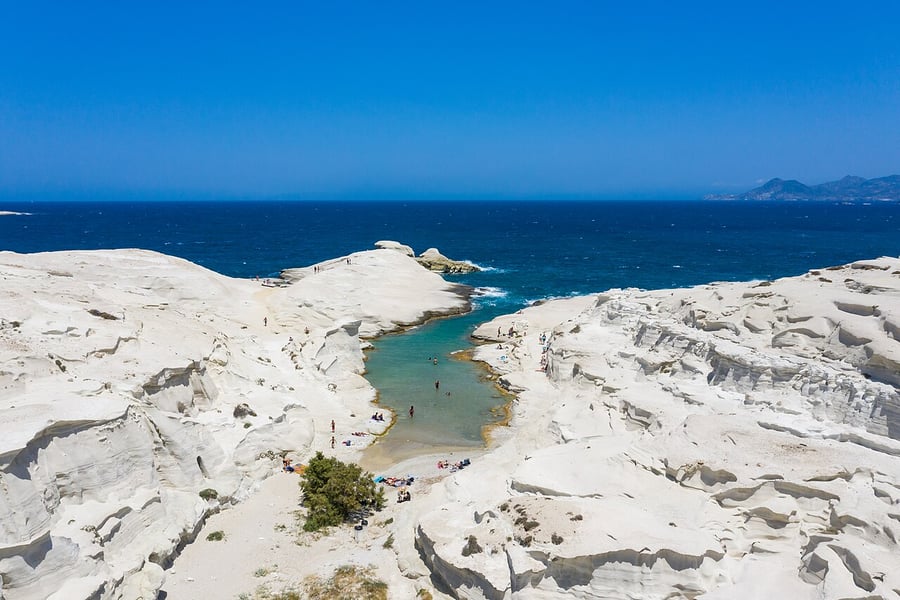
Volcanoes shaped Milos for millions of years, until activity stopped 90,000 years ago. That volcanic soil is why the beaches differ so much. One has golden sand, the next has pebbles, and nearby rocks are white, red, yellow or black.
The outline of Milos is a horseshoe, and a big bay bites deep into the middle. Any trip to Milos with kids is shaped by that bay. This bay ranks among the Mediterranean’s largest natural bays, and among its safest.
The island counts over 75 beaches, small and large, with clear blue water. Local lists sort them by side of the island: north, south, east and west, plus the bay. Fully organised beaches sit alongside lonelier and wilder ones.
Papikinou lies 1 km east of Adamas, while Provatas is 7 km from the town. The strip of land that links the two halves is no more than 2.2 km across. That keeps Milos with kids simple to organise.
The west of Milos is the island’s wildest side. Villages are absent there, and almost all of it is a protected nature area. Its beaches are isolated, unlike the bay side, which holds the port and the chief town.
- Capital: The chief town, Plaka, sits high above the harbour on a plateau.
- Port: Adamas is the harbour town on the bay’s north-east side.
- Size: Milos is about 23 km long, from east to west, and 13 km wide.
- Neighbour: Kimolos lies less than 2 km to the north-east.
- Crowds: The island draws fewer visitors than Santorini and Mykonos, so it feels less crowded.
These basics shape the whole plan for a family. A volcanic island, a wide bay and short distances give Milos with kids a clear base. The next section looks at how a family reaches that bay by sea or by air.

How does getting to Milos with kids work?
Getting to Milos with kids means choosing between the sea and the air. Boats arrive at Adamas, the main port, inside the bay. Planes land at the small airport on the island, and cars or taxis carry passengers onward.
The sea route starts at the port of Piraeus and ends at Adamas. A direct sailing goes straight to Milos, while other sailings stop at Kythnos, Serifos and Sifnos first. The page on getting to Milos lists the full routes.
Arriving by boat, a family sees Adamas first, because it is the main port. The town hugs the bay’s north-east edge, where water fills the hollow of an old volcanic crater. Families who arrive for Milos with kids land in the largest tourist centre on the island.
Milos has its own small airport, southeast of Adamas. The runway is short and the apron is small, so only small planes can land there. Direct flights arrive from the Athens airport, and the flight itself is short.
In the summer months, boats also connect Milos with other islands, among them Syros, Paros, Naxos and Santorini. A family can therefore add Milos with kids to a longer island trip. Crete and Rhodes are on that list too.
A private boat is another way to reach Milos with kids. The marina at Adamas offers water and electricity, and the boat can also moor in Pollonia. Pollonia is the small port that links Milos with the neighbouring island of Kimolos.
- Sea: Boats run from Piraeus to the port of Adamas.
- Direct: One sailing goes straight to the port of Milos.
- Stops: Other sailings stop at Kythnos, Serifos and Sifnos, with Kimolos added at times.
- Air: Direct flights link the Athens airport with the airport on Milos.
- Marinas: Private boats can moor at Adamas or at Pollonia.
The choice of boat or plane decides where the trip begins, not how it goes after that. Either way, Milos with kids starts on the bay side of the island, near Adamas. The next section moves from the port to the shore.
Which sandy, shallow beaches suit Milos with kids?
Milos with kids fits best on beaches with sand and shallow water, and five of them stand out. Provatas, Firiplaka and Achivadolimni combine sand with shallow water. Papikinou has water that deepens slowly, and Pollonia has rich sand.
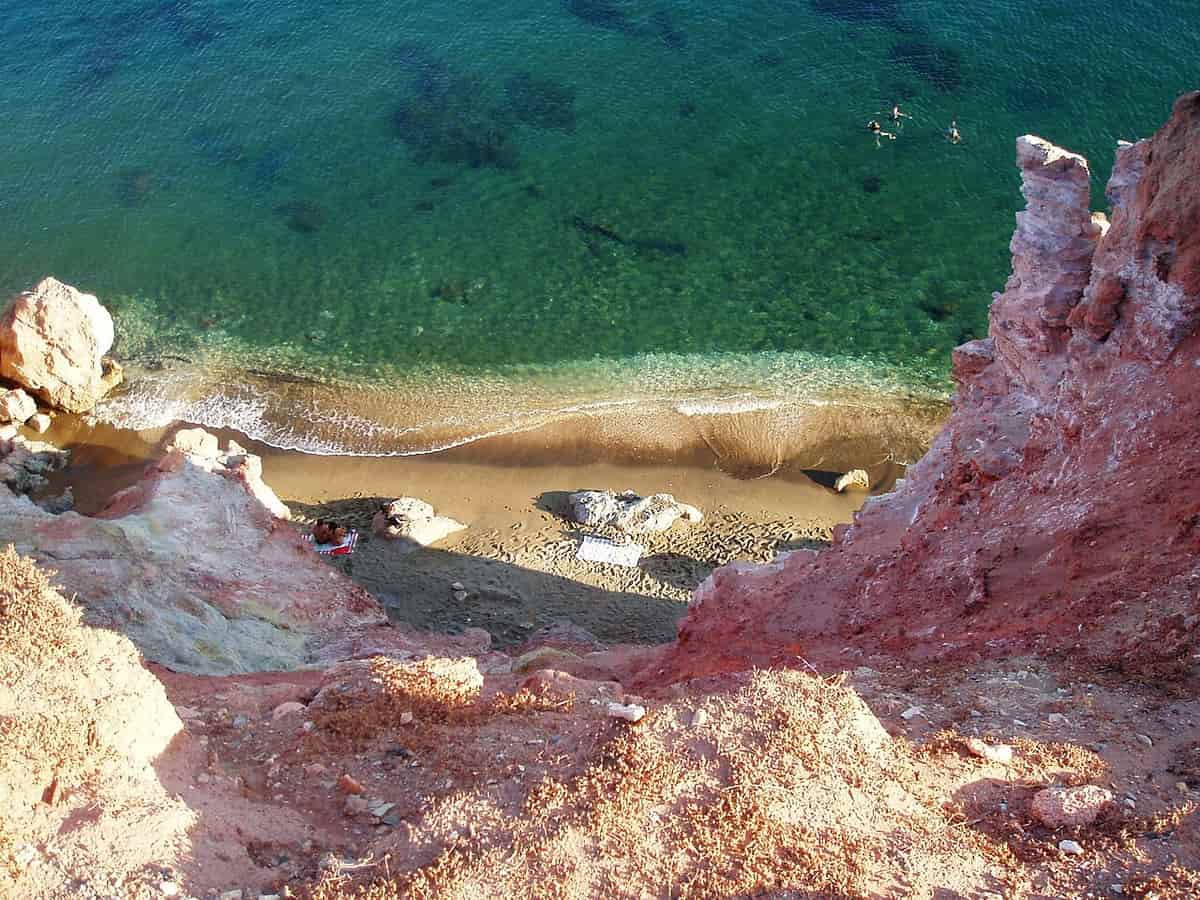
For Milos with kids, Provatas is a family beach with golden-red sand, coloured by iron oxides. Its very shallow water suits children at play. Sunbeds, umbrellas, rooms to let and taverns are all there, and a bus line serves the beach.
Papikinou, just outside Adamas, is a large beach with tamarisk trees, umbrellas, sunbeds and a restaurant. Its water deepens slowly, which suits children. Its waves are among the gentlest on the island.
Firiplaka lies on the south coast, next to Provatas. The sand is fine and white-grey, white pebbles mix in, and the turquoise water is shallow. A beach bar and sunbeds serve the organised part, and the last stretch of road is gravel.
The largest beach on Milos is Achivadolimni, with white sand and shallow, deep-blue water. Its first sandy part is quieter, while the second is busier, with a beach bar and restaurants. Surfers and kitesurfers like it too, and buses serve it.
Pollonia is a fishing village wrapped around a cove. Its beach has rich sand and plenty of tamarisk trees, and boats link the village with Kimolos. The village has taverns, restaurants and cafes, and cars reach it easily.
- Sand: Provatas, Firiplaka, Achivadolimni and Pollonia all have sandy shores.
- Shallows: Provatas, Firiplaka and Achivadolimni have shallow water.
- Slow depth: Papikinou has water that deepens slowly.
- Trees: Papikinou and Pollonia have tamarisk trees.
- Buses: Buses reach Provatas, Firiplaka and Achivadolimni.
Five beaches give a family a firm start. Readers who want the whole coast, zone by zone, can follow the link to the beaches of Milos. Milos with kids then grows from these shallow, sandy shores toward the quieter coves.
Where does Milos with kids find calm beaches on windy days?
Milos with kids works best on windy days at bay beaches or south-coast beaches. The summer meltemi blows from the north, so the far side of the island stays calmer. Families plan every beach day around the wind direction, not around the view.
In summer, a dry north wind called the meltemi crosses the Aegean Sea. Its season starts in late spring and ends in the middle of September. The skies stay clear, so a windy day on Milos with kids still looks bright and sunny.
Gusts peak in the afternoon and can fade after dark. A single spell can last for days on end. On the sailors’ Beaufort scale, it can reach force 7 or 8. Wind that strong lifts sand and tips umbrellas.
The north coast faces the wind head on, so the waves roll in with it. The south coast looks away from the wind, so the water there stays calmer. The island also curls like a horseshoe around a large bay with calm beaches.
On a meltemi day, Milos with kids does well at a beach in the bay. Beaches on the south side of the island do even better. The bay has 25 beaches and the south coast has 21, so calm choices are plentiful.
A wind from the south reverses the picture, and the northern beaches turn calm. Milos with kids works with either wind once a parent checks the direction. Wind cools the skin, but sunburn still happens, so hats stay on.
- Bay beaches: These are the first choice when the meltemi blows.
- South coast: These beaches face away from the north wind.
- North coast: These beaches take the full push of wind and waves.
- Waves: An adult stays within arm’s reach at the water’s edge.
- Loose items: Towels, toys and umbrellas need weight on top.
A trip to Milos with kids on a windy day needs one habit. The family checks the wind first and then picks the coast. Calm water makes the beach easier for small children and their parents. Sarakiniko, on the north shore, asks for more care.
Is Sarakiniko a good stop for Milos with kids?
Milos with kids can include Sarakiniko, but the visit needs care and a plan. The white rock has ledges above the water and very little shade. Families do best on the small sandy inlet, with an adult close to every child.
Sarakiniko is found on the northern coast of the island, beside the Aegean Sea. Its white volcanic rock was shaped by waves that north winds drive against it. The rock looks so bare that people compare the place to the surface of the moon.
Only a small slice of Sarakiniko is actual beach. It sits in an inlet closed in by white rock, with thin sand and green-blue water. The inlet is the family base, and the bare rock around it is for short walks.
Visiting Milos with kids means extra care on the rock ledges above the water. Wet stone can be slippery, and edges are hard on bare feet. Children need shoes with a good grip, and an adult checks the water below before anyone jumps.
The site has almost no plants, and the white rock reflects the sun. Shade is scarce, with only a couple of trees giving small patches behind the beach. Hats, sun cream and water come first when Milos with kids includes Sarakiniko.
Pirates once sheltered at Sarakiniko, and that history explains its name. Old posts for tying up ships can still be seen cut into the stone. Fossils are plentiful between the layers of volcanic rock, which keeps curious children busy.
- Sandy inlet: The small sandy inlet is the natural base for a family.
- Ledges: Rock ledges sit above the water, so children stay back.
- Wet rock: Wet stone can be slippery, so grippy shoes help.
- Sun: White rock reflects the sun and gives almost no shade.
- Wind: North winds drive waves onto this shore, so care rises.
The page on Sarakiniko beach covers the rock formations in more detail. For Milos with kids, a calm day suits this stop best of all. Shoes, hats and water go in the bag, and children stay near an adult at all times.
Are boat trips to Kleftiko right for Milos with kids?
Milos with kids can include a boat trip to Kleftiko, but the sea sets the plan. A day on the water brings sun, waves and swim stops. Families need a calm sea, shade on board and an adult near every child.
Kleftiko is a cluster of pale rocks in strange shapes, riddled with caves and pits. Wind and waves have worn the stone into hollows over the centuries. The strange forms are best seen from the water, on a boat or sailboat.
Boat trips leave from harbours such as Adamas and Pollonia. They reach beaches that land routes cannot reach, and they stop at caves and swim spots. Along the coast, passengers can also admire the mineral wealth of the island.
Swim stops can happen in open water, away from any shallow beach edge. The water can be deep, so an adult stays within arm’s reach of each child. A safety vest in the right size makes sense for small swimmers.
On the sea, the sun shines from above and bounces off the water. On a boat, Milos with kids means hats, sun cream, water and a shaded spot on board. Waves can also leave small children feeling seasick, even in fine weather.
The meltemi can raise waves under a clear sky. It arrives without warning, and a strong one can stop small-boat routes. A trip to Milos with kids works best when the family stays ready to change the plan.
- Kleftiko: Wind and sea carved its caves and pits in the pale rock.
- Sea caves: Trips can include caves along the coast.
- Swim stops: An adult stays within arm’s reach of each child.
- Sun: Hats, sun cream and water stay close, and shade helps.
- Waves: Rough water can upset a small child’s stomach.
One way onto the water is a Milos catamaran cruise, on a boat with two hulls. Parents can ask the crew what safety gear the boat carries before it leaves the port. On a windy day, Milos with kids is easier on a beach inside the bay.

Is the castle hill in Plaka a good sunset walk for Milos with kids?
Milos with kids works well on the castle hill above Plaka. The village is closed to cars. A Venetian castle crowns the top of the hill. At sunset, families look across the bay toward the next islands of the Cyclades.
Plaka is the island capital, and a day of Milos with kids can start here on foot. The village sits on a big rock high over the gulf. Cars cannot enter. Only motorbikes and mopeds are small enough to pass between the houses.
Milos with kids can trace how the town grew. The old castle filled up with families. New houses spread onto the flat ground below, and that flat ground gave Plaka its name. The castle is Venetian work from the 13th century, and it sits on a hill of volcanic origin.
The top of Plaka belongs to the castle, on a rocky hill above the ancient town. From there, the island kept watch over the ships in the bay of Adamas. For Milos with kids, the hill works as a real lookout post. Wartime defences from the German occupation left remains here too.
The church of Panagia Thalassitra, the patron of sailors, stands along the way up. It draws more photographs than any other church on the island. At the summit, Mesa Panagia is a small church with an arched roof. Villagers rebuilt it after 1944, because the occupation years destroyed the earlier chapel.
- Height: Plaka lies 220 metres above sea level.
- Alleys: The lanes of cobbles began as a defence against pirates.
- Name: Plaka comes from the flat ground below the castle.
- Marble yard: Panagia Korfiatissa has a courtyard paved with old marble tombstones.
- Sunset: The castle and Panagia Korfiatissa both offer sunsets.
Panagia Korfiatissa clings to steep rocks at the far western edge of Plaka. Sea views come with it too. Plaka is almost joined to Trypiti. So Milos with kids moves easily from the castle hill to the ancient sites there.
Which ancient sites near Trypiti suit Milos with kids?
Milos with kids can reach three ancient sites near Trypiti on foot. They are the early Christian catacombs, the Roman theatre and the Venus de Milo find spot. All three lie close together on the slope above the bay of Adamas.
The name Trypiti means “made with holes”. Caves cut into soft volcanic rock surround the village. Locals still use them as storerooms and stables. Ancient families used caves like these as burial chambers. So Milos with kids can see old and new uses of the same caves.
The catacombs are an underground cemetery from the first Christian centuries. Passages measure 1 to 5 metres across. Ceilings stand between 1.6 and 2.5 metres tall. Visitors enter gallery B only, and a wooden platform runs through it.
Milos with kids can look for the arched tombs in the walls, called arcosolia. Along the right wall is a tomb with two levels, the only one of its kind there. Red capital letters of an old inscription survive nearby. A central rock was a table for services. Locals once called the place the Greek cave.
The ancient theatre lies 200 metres west of the catacombs. Builders raised it in the Roman period on a natural volcanic slope. Eight marble stairways divide the lower seats into seven blocks. The floor in front of the stage sits 1.6 metres below the first row. This made it an arena.
The Venus de Milo came from this hillside. A farmer found the statue in 1820. The find spot lies just past the walls of the ancient city. An alley at the end of the road from Trypiti leads there. A hand holding an apple lay beside the statue.
- Village: Trypiti is named after the holes in its volcanic rock.
- Catacombs: The galleries keep 126 carved arched tombs.
- Theatre: People lived and worked in its spaces until the 6th or early 7th century AD.
- Sound: The hillside theatre looks over the port and has very good acoustics.
- Statue: The original Venus de Milo is displayed in the Louvre in Paris today.
A separate page tells more about the catacombs of Milos. The three sites sit close together. Milos with kids can cover them on foot around Trypiti. A plaster copy of the statue in the museum in Plaka completes the story.
Which museums suit Milos with kids?
Milos with kids can start with three museums. The archaeological and folklore museums stand in Plaka, and the mining museum stands in Adamas. Each one shows real objects, from ancient finds and old homes to the rocks beneath the island.
The archaeological museum stands in Plaka, in a building from 1870. A plaster cast of the Venus de Milo greets visitors at the entrance. The halls then follow life on Milos from the Neolithic age to the Roman era. Milos with kids can follow the objects in time order.
The first hall holds obsidian tools. Obsidian is a volcanic stone that made Milos a trade hub. The Goddess of the Serpents, a clay figure, stands out there too. The smaller halls show daily life. Lamps, children’s toys and a clay horse that is 2,500 years old are on show.
In Plaka, the folklore museum lies just behind Panagia Korfiatissa, the main church. Milos with kids can walk through a town house of the 19th century on two floors. Rooms include a living room, a loom workplace, a kitchen, a bedroom and a cellar for farm goods. Furniture, clothes, textiles and old photographs fill them.
The mining museum stands in Adamas, the main port. The ground floor tells the story of mining, with old tools, maps and photographs. The upper floor shows mineral samples, a touch screen and a hands-on section. Milos with kids can watch films on how minerals are mined. A volcano model stands by the stairs.
- Archaeological: A plaster Venus de Milo stands at the entrance in Plaka.
- Toys: A small clay horse is a child’s toy from 2,500 years ago.
- Folklore: Two floors show a 19th-century town house in Plaka.
- Mining: The Adamas museum holds a volcano model and hands-on minerals.
- Others: A church museum and a naval museum also stand near the harbour of Adamas.
A separate page lists more about the museums of Milos. These three museums suit Milos with kids. Each holds objects that a child can name: a horse, a loom, a rock. Together, they cover ancient times, home life and geology.
Which fishing villages suit Milos with kids?
Milos with kids suits Klima, Mandrakia and Firopotamos, three small fishing villages built in coves. Their boat garages, called syrmata, are dug into soft rock or into natural hollows of the rock. Each village also has a beach of its own.
Klima lies at the mouth of the bay of Milos, below the village of Tripiti. The port of Adamas is 6 km away. The census counted only eight residents. That small size suits Milos with kids, because the whole village can be seen at a slow pace.
A syrma is a house with a boat garage below it. The boat rested on the ground floor in winter, and the family lived upstairs. The Greek name means wires. Strong paint colours cover the doors and windows. Today a number of these houses take holiday guests.
Cats stretch out in the sun beside the painted doors. Klima has its own beach, and nearby Schinopi has another. Both suit swimming. That gives children a cool-down after a look around the village, before the next stop.
Mandrakia is a traditional fishing village ringed by painted syrmata. It gives Milos with kids a quiet beach of almost 150 metres. The sand comes with fine dark grey pebbles, and tamarisk trees stand beside it.
Firopotamos adds a sandy, organised beach to Milos with kids, and the water suits swimming. A small inlet is ringed by syrmata. Past the fishing houses stand a church and an old loading ladder that nobody uses now.
- Klima: Ruins of the old island town and its first harbour lie close by.
- Mandrakia: Rooms for rent and a restaurant stand beside the beach.
- Firopotamos: A beach bar serves the sandy shore.
- Syrmata: These cave dwellings first sheltered boats in winter and in bad weather.
- Care: Parents keep children away from boats, ropes and wet rock at the edge.
A trip to Milos with kids can link the three villages on one coastal route. Each shows the same fishing tradition in a different cove, and each has a beach nearby. The page about Klima adds more detail about the first stop.
What does the mining past add to Milos with kids?
Milos with kids gains a second story from the mining past. The old sulphur mines at Thiorichia stand beside a cove, with wagons, rails and rusty tools left behind. Beyond them, the island’s rocks gave the world obsidian, clay and other minerals.
The sulphur mines at Thiorichia worked until 1956. Their ruins lie at Paliorema, a small cove with yellowish pebbles and clear water. The beach is a geological sight of the island. Milos with kids can fit a swim and a history lesson into one stop.
Wagons still sit on their rails there. Spare parts that were never used sit in the warehouse beside old rusty tools. These objects show how the works ran. Children watch from outside, and parents keep everyone clear of the old buildings, the rails and the wagons.
The dirt road drops into the Palioremata ravine and finishes at the old works. No other industrial site on Milos has protected status. This one is listed as a historic site and a sample of industrial heritage.
Milos holds more than sulphur. Its volcanic ground gives bentonite (a clay), perlite and a little kaolin. It also gives pozzolana, a volcanic earth used in cement. Workers dig these from open pits, and buyers across the world take the minerals. In earlier times, miners also took baryte, millstones and gypsum.
Obsidian is the oldest mining story for Milos with kids. It is a glass-like rock made by volcanoes. Milos obsidian was a trade good 15,000 years ago. Travellers came by boat, pulled up in a cove and cut pieces from the quarries. They made extremely sharp stone tools from it, long before farming began.
- Kaolin: Old tunnels in the Lagada ravine show where white kaolin was dug.
- Rock shapes: Sea air has carved rocks that sometimes look like open-mouthed animal heads.
- Pigment: Ancient artists made white paint from Milos earth, mostly kaolin.
- Perlite: Heat turns this rock into a white mass of tiny glass bubbles.
- Safety: The mine buildings stay out of bounds, and watching from outside is enough.
The mining past adds volcanoes, glass and clay to Milos with kids, beside the sand and sea. Thiorichia needs one look from outside, because the cove, rails and rusty tools sit together. The rule is simple: eyes on the ruins, hands off.
How does getting around work for Milos with kids?
Getting around Milos with kids uses summer buses, taxis, cars and boats. Buses serve certain areas, and their routes run quite frequently in the summer months. Taxis serve the port and the airport. Dirt roads cover the west, so those beaches need a slower plan.
Town buses link certain parts of the island, and tickets are bought on board. In summer the routes are quite frequent. No bus runs to or from the airport. Families with luggage therefore take a taxi or a rental car for that first trip.
Milos counts 15 taxis. A taxi can be found where ferries dock and where planes land. The cars are fairly new, roomy and air conditioned. For tired children and heavy bags, a taxi is the simplest way to reach a first stop.
A rental car lets a family set its own plan for Milos with kids. Milos has more dirt roads than any other Cyclades island. Such roads end at coastal sites, chapels and mines. Certain stretches are very hard to drive, so the driver checks each road first.
Milos with kids needs extra care in the west. No villages exist in the wildest half of the island, only a handful of settlements. The beaches are isolated, so a family carries water and food. At Agios Ioannis, only the first of three beaches has car access.
Boats reach what roads cannot. Sea trips visit beaches that have no land access. The trip boats set out from the ports of Adamas and Pollonia. For small children, a boat day replaces a long drive on dirt.
- Agios Ioannis: Reaching this beach in three parts means crossing about 12 km of dirt road.
- Agkathia: The dirt road makes this long sandy beach hard to reach.
- Thiorichia: A passable dirt road runs down to the old sulphur mines.
- Sykia: This sea cave can be entered only from the water.
- Snakes: The Milos viper lives in the west, so shoes stay on and paths stay in use.
A plan with one area per day keeps Milos with kids simple. Buses and taxis cover the busy parts of the island. A car or a boat reaches the rest. A Milos itinerary sets the order of the stops. Water goes into the bag every morning.

Which village works best for Milos with kids?
Milos with kids has three good bases: Adamas, Pollonia and Plaka. Adamas is the main port on the bay. Pollonia is a small seaside village in the north-east. Plaka is the car-free hill capital under a castle.
Adamas is the main port of Milos. It is also the largest tourist centre on the island. The town lies on low ground, on the north-eastern shore of the bay. Papikinou, a big beach one kilometre east, has water that deepens slowly. That suits small swimmers.
The bay itself shapes the choice. It is a large, safe natural bay, and Adamas sits on its shore. Shops gather close to the port, so a quick errand takes only minutes on foot. That helps on days when small children tire early.
Pollonia is a small village on the north-eastern tip of Milos. It sits about ten metres above the sea. Its sandy beach has tamarisk trees, and two more beaches lie close by. Fishing boats come in every morning. A small boat also runs to Kimolos.
Plaka is the capital of the island. It stands 220 metres above sea level, with a view over the bay. No cars enter the village, as the lanes between its houses are tight. Only motorbikes and mopeds pass. A Venetian castle crowns the hill. Cobbled lanes call for sturdy shoes.
A trip to Milos with kids starts easily in Adamas. The port, the shops and a gentle beach sit close together. Pollonia suits families who want a small village shore and a short crossing to Kimolos. Plaka suits an evening visit better than a stay with a baby.
- Adamas: the main port, near the shops and Papikinou beach.
- Pollonia: a seaside village with its own beach and the boat to Kimolos.
- Plaka: the hill capital with a castle, narrow lanes and no cars.
- Distance: Pollonia lies almost ten kilometres from Adamas and fourteen from Plaka.
- Slope: Plaka stands 220 metres above the sea, but Pollonia sits only ten metres up.
Each base has its own pace. The airport lies a short drive from the port of Adamas, so arrival days run smoothly there. Pollonia and Plaka lie farther out, so they call for a drive or a taxi ride. For a closer look at each settlement, parents can turn to the villages of Milos.
How does summer heat shape a day on Milos with kids?
Milos with kids works best when the day follows the sun. Swims fit the morning and the late afternoon, and midday belongs to shade and rest. Summers are dry, with a mean daily high of 28.1 °C in July.
The island follows a Mediterranean pattern. Winter brings mild days and rain. Summer brings warm to hot weather and almost no rain. In June the average daytime high is 27.1 °C. July reaches 28.1 °C and August 27.6 °C. July gets only 0.3 mm of rain.
The record high is 44.0 °C, set in June. A hot spell can still arrive. From the middle of spring to mid-September, the meltemi blows. This strong, dry north wind peaks in the afternoon and eases at night. It cools the air but stirs up waves.
The island is dry, and plants cover little of it. Shade is not always close by. Pollonia has tamarisk trees on its beach. Elsewhere, families bring their own: an umbrella, a hat and a light shirt. Sun cream goes on before the first swim and again after drying off.
A workable day on Milos with kids starts with a swim in the cool morning air. At midday, the family retreats to shade, a cafe or a room for lunch and a rest. In the late afternoon the sun drops, and the beach is pleasant again.
The hottest hours suit a museum visit. Adamas has two of them, the mining museum and the maritime museum. Plaka holds the archaeological museum on its hill. Cool rooms and old objects give children a break from the sun. Each visit adds a story to share later at the beach.
- Morning: swim and play on the beach before the heat builds.
- Midday: rest in shade or indoors, or visit a museum in Adamas or Plaka.
- Late afternoon: return to the water when the sun sits lower.
- Water: carry a full bottle of drinking water for each child.
- Sun cream: put it on before each swim, then add a hat and a shirt.
Planning around the heat keeps children cheerful and adults calm. Outings fit best in the cooler parts of the day. A windy afternoon can change the plan. The full list of activities in Milos has ideas for every part of the day.
What do parents ask about Milos with kids?
Milos with kids raises eight steady questions. They cover the best month and the right age. They also cover prams, wind and rain, kayaking and snorkelling. The last two cover Kimolos and food. Each answer is short and practical.
When is the best month for Milos with kids?
June and September suit Milos with kids well. Mean daily highs are 27.1 °C in June and 25.2 °C in September, with little rain. July and August run a little hotter, at 28.1 and 27.6 °C. Winter is mild but wet. The meltemi wind fades by mid-September.
What age suits Milos with kids?
Milos with kids can work at any age, but the plan changes. Toddlers do well on beaches where the water deepens slowly, such as Papikinou. School-age children can climb to the castle in Plaka and ride a boat. Teenagers can add snorkelling and kayaking along the volcanic coast. Babies need shade and short outings.
Is Milos with kids easy with prams and steps?
Adamas lies on low ground, so its streets are the easiest for wheels. Plaka bans cars, but its lanes are narrow and cobbled. Plaka itself stands 220 metres up, and the castle crowns its hill. A baby carrier works better there than a pram. Pollonia is small and sits only ten metres above the sea.
What do families do on a rainy or windy day on Milos with kids?
Rain is rare from June to August, but December averages 90.3 mm. Wind is the usual problem. The meltemi can keep small boats and inter-island ferries in port. On such days, families visit the museums of Adamas and Plaka. They can also swim inside the bay, a large and safe natural harbour.
Can families go kayaking on Milos with kids?
Sea kayaks explore the volcanic coast, its caves and its quiet beaches. Kayak trips run from April to October. Calm water and a short, easy route suit families best. Children can paddle with an adult in a shared kayak. The age limit depends on the organiser, so parents ask before planning.
Where can children snorkel on Milos with kids?
The water around Milos is clear. Children can try snorkelling in shallow, sheltered water close to the shore. A mask, a vest and an adult within reach make it safer. A beach with mild waves, such as Papikinou, is a gentle start. Deep caves and the open sea belong to older swimmers.
Is a day trip to Kimolos realistic on Milos with kids?
Kimolos lies one kilometre north-east of Milos, across a narrow channel. A small boat links it with Pollonia, and local ferries join the two islands too. Buses and taxis on Kimolos run to popular beaches. A mushroom-shaped rock called Skiadi gives children something to see. Parking is tight in summer.
What food suits children on Milos with kids?
Pollonia has taverns, cafes and restaurants along its shore. Local boats land fresh fish there every morning. Parents can ask for plain grilled fish, bread, rice, pasta or fruit. A small portion suits a child. Simple dishes keep a tired child happy. Snacks and water travel well in a beach bag.